Frequently Asked Questions
Common questions about clinical research coordination, certifications, regulatory frameworks, and how to start a career in clinical research. Each answer links to a longer-form article with primary-source citations.
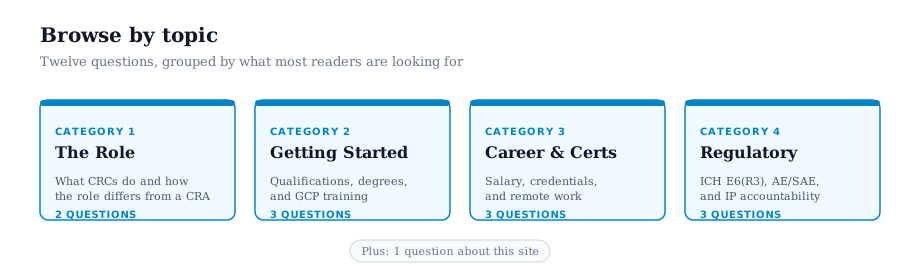
This page collects the questions we hear most often from working coordinators, students considering the field, and readers new to clinical research. Answers are short by design — for the regulatory grounding, methodology, edge cases, and worked examples behind each answer, follow the link at the end of each section to the relevant full article.
What does a Clinical Research Coordinator (CRC) actually do?
A CRC manages the day-to-day operations of a clinical trial at a research site. Core responsibilities include screening and enrolling participants under the principal investigator's supervision, obtaining informed consent, scheduling and conducting study visits, collecting and entering data, managing investigational product accountability, reporting adverse events, and serving as the primary point of contact for sponsors and monitors. The role sits at the intersection of clinical care, regulatory compliance, and data management.
What qualifications do I need to become a CRC?
Entry-level CRC positions in the United States typically require a bachelor's degree in a life science, nursing, or related field, though some sites hire associate-degree holders or licensed practical nurses with relevant clinical experience. Most positions require completion of Good Clinical Practice (GCP) training before working on regulated trials. A clinical research certification (CCRC, CCRP, or ACRP-CP) is generally not required for entry but is often expected for advancement to senior or lead coordinator roles.
Do I need a science degree to work in clinical research?
Not always. While a life sciences or nursing background is the most common path, many working coordinators came from public health, psychology, social work, or other allied health degrees. The minimum requirement is generally a four-year degree plus the ability to learn medical terminology, basic pharmacology, and regulatory frameworks quickly. Non-science majors who succeed in this field typically do so by completing GCP training before applying and by accepting an entry-level assistant role first.
What is the difference between a CRC and a CRA?
A Clinical Research Coordinator (CRC) works at a research site and is responsible for running the trial day-to-day with participants. A Clinical Research Associate (CRA) usually works for the sponsor or a contract research organization (CRO) and monitors multiple sites to verify that they are conducting the trial correctly. CRAs travel frequently for monitoring visits; CRCs are typically based at a single site. The two roles are complementary and many CRAs start their careers as CRCs.
What is the average salary for a CRC in the United States?
According to the U.S. Bureau of Labor Statistics (May 2024 data), the broader Social Science Research Assistants category (which includes clinical research assistants) had a mean annual wage of $63,560. Working CRC salaries vary significantly by region, experience level, and employer type — academic medical centers, hospital-based sites, and dedicated research centers each pay differently. Senior coordinators and lead CRCs with certification and 5+ years of experience commonly exceed the mean. Always verify current local salary data; numbers change.
Are CRC certifications (CCRC, CCRP, ACRP-CP) worth getting?
For working coordinators who plan to stay in the field, certification is generally worth pursuing. It typically results in higher base pay (small but consistent), is increasingly expected for senior roles, and signals professional commitment to sponsors and employers. The three main certifications (CCRC from ACRP, CCRP from SOCRA, and the newer ACRP-CP credential) all require documented work experience plus passing an exam covering regulatory frameworks, GCP, and clinical research operations. Choose based on which is most recognized in your region or by your employer.
What is Good Clinical Practice (GCP) and how do I get certified?
Good Clinical Practice (GCP) is the international standard for the ethical and scientific quality of clinical trials involving human participants, codified in ICH E6 (now in its R3 revision). GCP training is typically required before you can work on any regulated trial. Free or low-cost GCP training is available through CITI Program, NIH's PRIDE course, and the Transcelerate-recognized provider list. GCP "certification" is generally a certificate of completion, not a formal credential — it is renewable every two to three years depending on the provider.
What is ICH E6(R3) and when does it take effect?
ICH E6(R3) is the third major revision of the international Good Clinical Practice standard. It reached Step 4 (finalization by the ICH Assembly) on January 6, 2025. The FDA formally adopted E6(R3) on September 8, 2025; the EMA's adoption became effective on July 23, 2025. ICH E6(R3) emphasizes a risk-proportionate, principles-based approach and updates expectations around electronic systems, decentralized trial elements, and sponsor-site responsibilities. Annex 2 (covering interventional trial designs in greater detail) is expected in early 2026.
What is the difference between an Adverse Event (AE) and a Serious Adverse Event (SAE)?
An Adverse Event (AE) is any untoward medical occurrence in a participant during a trial, regardless of whether it is related to the study intervention. An AE becomes a Serious Adverse Event (SAE) if it meets any of the seriousness criteria defined in 21 CFR 312.32: death, life-threatening, hospitalization or prolongation of hospitalization, persistent or significant disability or incapacity, congenital anomaly, or any other medically important event. SAEs have specific sponsor and IRB reporting timelines that AE-only events do not.
What is investigational product (IP) accountability?
Investigational product accountability is the regulatory requirement that every unit of study drug (or device) be tracked from receipt at the site through dispensation to the participant and either return to the sponsor or destruction. It is codified at 21 CFR 312.62 for FDA-regulated trials and ICH E6(R3) Section 5.14 for international trials. IP accountability records are one of the most consistently cited findings in FDA Bioresearch Monitoring (BIMO) inspections — discrepancies are mathematical and therefore easy for inspectors to identify.
Can I work remotely as a CRC?
Partially. Some CRC responsibilities can be performed remotely (data entry, query resolution, regulatory document preparation, sponsor communication), but core duties — participant visits, informed consent, drug accountability, source documentation — require physical presence at the site for most trials. The growth of decentralized clinical trials (DCTs) since 2020 has increased the proportion of remote work for some coordinator roles, particularly at fully decentralized sites, but a fully remote traditional CRC position is still uncommon. Sponsor-side and CRO roles (CRA, clinical project manager) offer more remote flexibility.
Is The CRC Toolkit affiliated with any sponsor, CRO, or regulator?
No. The CRC Toolkit is an independent educational resource published by a single practicing Certified Clinical Research Coordinator. We are not affiliated with, endorsed by, or sponsored by the FDA, EMA, ICH, NIH, ACRP, SOCRA, any sponsor, contract research organization, academic medical center, or professional society. All regulatory citations on this site point to publicly available primary sources; for the authoritative current text of any regulation, always consult the issuing authority directly. See our disclaimer page for the full statement of scope and independence.
Have a question that isn't covered here? Email ask@thecrctoolkit.com and we may add it to this list or use it as the seed for a new article. See the Contact page for response time and the scope of inquiries we can answer.