A science degree is one of the strongest foundations for a clinical research career, not because it provides direct experience in clinical trials, but because it builds the underlying competencies the field requires: comfort with precise protocols, quantitative reasoning, familiarity with research methodology, and an instinctive understanding of why data integrity matters. The gap between a science degree and a clinical research role is smaller than most new graduates realize. The challenge is knowing how to close it strategically.
This guide is written for science graduates — biology, biochemistry, chemistry, psychology, pre-medicine, public health — who are trying to map a realistic path into clinical research in 2026. It draws on the actual regulatory framework governing research qualifications, official labor market data from the Bureau of Labor Statistics, and the NIH's published guidance on research workforce requirements. The advice here is grounded in what the field actually requires, not in generalized career platitudes.
Why Science Majors Are Well-Positioned for Clinical Research
The clinical research field requires a specific combination of competencies that science education develops directly. Understanding this connection, and being able to articulate it to hiring managers, is the first strategic advantage a science graduate can leverage.
The ICH E6(R3) Good Clinical Practice guideline, finalized January 2025, specifies that each individual involved in conducting a clinical trial should be qualified by education, training, and experience to perform their respective tasks. Education is listed first, and it is listed there because it is the foundation. The guideline's qualification framework explicitly recognizes that academic preparation is a legitimate component of the qualification that enables someone to perform clinical research tasks.
What specifically does science education provide that translates? Protocol adherence, the ability to follow multi-step, precisely written procedures without deviation — is trained in every undergraduate laboratory course. Data recording discipline, including the principle that observations must be recorded as they happen rather than reconstructed from memory, is the same principle that governs ALCOA-compliant source documentation in clinical trials. Statistical literacy — understanding the difference between a significant result and a meaningful one, knowing why sample size matters, recognizing confounding — makes clinical data interpretation accessible rather than opaque. These are not generic "transferable skills." They are directly relevant competencies that science graduates possess and that clinical research requires.
What the Regulatory Framework Says About Your Qualifications
Before you can position your background effectively, you need to understand exactly what qualification standard applies to entry-level clinical research staff. The answer is in the regulations, and it is more accessible than most candidates assume.
The FDA's guidance on Investigator Responsibilities states that the investigator should ensure any individual to whom a task is delegated is qualified by education, training, and experience to perform that delegated task. This is the standard applied when a Principal Investigator assigns clinical research tasks to their team, not a fixed resume requirement imposed by HR, but a flexible standard that considers the combination of all three elements.
Under 21 CFR Part 312, investigators must maintain adequate records of the investigation, and all study personnel must be appropriately qualified. "Appropriately qualified" is not defined as "has two years of prior clinical research experience." It means qualified — by whatever combination of education, training, and demonstrated experience — to perform the specific tasks assigned. A biology graduate who has completed GCP training and has laboratory research experience is appropriately qualified to perform data entry, regulatory binder organization, and participant scheduling tasks in clinical research. The regulatory standard does not require more than that.
Understanding this is useful in interviews. When a hiring manager asks why you are qualified for a role without prior clinical research experience, you can answer in terms of the regulatory framework: your education provides the scientific foundation; your GCP training provides the compliance knowledge; your laboratory, research, or clinical experience provides the procedural discipline. That is the qualification standard the regulations describe, and you meet it.
Translating Your Specific Degree
Different science degrees connect to clinical research in different ways. Understanding how your specific background maps to the field's needs helps you target the right roles and communicate your qualifications clearly.
Biology and Biochemistry
Biology and biochemistry graduates enter clinical research with direct relevance to the scientific content of trials — understanding pharmacokinetics, mechanism of action, biological endpoints, and laboratory procedures. The laboratory skills built in undergraduate coursework — sample handling, pipetting technique, protocol execution, data recording — are directly transferable to roles involving specimen processing, lab kit preparation, and lab results tracking in clinical trials. Biology graduates are particularly competitive for CRA and CRC roles in oncology, infectious disease, and laboratory-intensive therapeutic areas.
Chemistry and Pharmaceutical Sciences
Chemistry graduates bring particular strength to roles involving investigational product — understanding stability, storage requirements, compounding, and the significance of temperature excursions for drug products. This background is directly relevant to IP accountability and pharmacy coordination roles. Pharmaceutical science graduates who understand drug development processes already have substantial context for the IND/NDA pathway and can engage with protocol rationale at a deeper level than candidates without that background.
Psychology and Behavioral Science
Psychology graduates who have experience with IRB-approved research protocols are among the most naturally qualified entry-level candidates in the field. IRB experience — obtaining approval, managing consent, protecting participant confidentiality — is direct experience with the regulatory framework that governs all clinical research. Psychology's research methodology training (study design, control conditions, data collection, statistical analysis) maps directly to clinical trial literacy. Behavioral science graduates are also particularly well-suited for patient-facing roles requiring consent communication, given their training in human communication and behavior.
Pre-Medicine and Public Health
Pre-medicine graduates who did not proceed to medical school bring clinical awareness, basic anatomy and physiology knowledge, and familiarity with the healthcare environment. Clinical shadowing experience, volunteer work in hospitals, and exposure to patient populations all count toward the experience component of the qualification standard. Public health graduates bring epidemiological thinking, familiarity with research populations and health disparities, and often direct exposure to community-based research through academic programs — all highly relevant given the FDA's current mandate for diversity action plans in clinical trials.
The GCP Baseline: Complete Before You Apply
For science graduates entering clinical research, Good Clinical Practice training is the single most important credential to obtain before submitting your first application. The NIH/NIAID site personnel qualifications guidance requires documented GCP training for all staff performing study-related activities, with certificates maintained in the trial master file. Since January 2017, the NIH has mandated GCP training for all investigators and staff on NIH-funded clinical trials.
There is no regulatory requirement to wait until you are employed to complete GCP training. Completing it as a student or recent graduate, before your first application, communicates genuine preparation and removes one potential screening obstacle. Your GCP certificate should appear on your resume with the issuing organization and date of completion. When a hiring manager sees that you have already invested in the field's baseline credential, it demonstrates commitment rather than opportunism.
Human Subjects Protection Training: The Companion Credential
Alongside GCP, completing human subjects protection training — covering research ethics, informed consent principles, and the protections established by the Belmont Report and 45 CFR Part 46 — is standard preparation for clinical research roles. For NIH-funded research, the NIH/NIAID guidance requires both GCP and Human Subjects Protection (HSP) training. Both credentials can typically be completed online and together represent a few hours of investment that significantly strengthens an entry-level application.
The NIH Research Ecosystem: A Career Foundation
Science graduates in the United States have access to one of the world's most extensive publicly funded research infrastructures — the National Institutes of Health's network of funded research programs. Understanding this ecosystem gives science graduates specific, actionable targeting for their job search.
The NIH funds clinical research through multiple mechanisms: intramural research conducted at NIH's own facilities in Bethesda, Maryland; extramural research grants awarded to universities, academic medical centers, and research institutions nationwide; and cooperative agreements with clinical trial networks. The NIH's overview of clinical research notes that most clinical trials in the United States are approved and monitored by an Institutional Review Board — these IRBs are typically located at the same academic medical centers and universities that conduct NIH-funded research.
For science graduates, NIH-funded research at universities and academic medical centers is the single most accessible entry point into the field. These institutions value educational background and the willingness to learn; they are accustomed to developing early-career staff; and they often offer the tuition assistance and professional development resources that support ongoing training and eventual certification. A science graduate with strong academic credentials, GCP training, and research experience from their university has a genuinely competitive profile for entry-level positions at the institution where they studied.
The Academic Medical Center Pathway
Academic Medical Centers (AMCs) — hospital systems affiliated with universities and medical schools — are the most structurally accessible entry point for science graduates transitioning into clinical research. They are also among the best training environments in the field.
Several features make AMCs particularly well-suited for career entry. First, they conduct research across an unusually broad range of therapeutic areas and study types simultaneously — a single large AMC may be running NIH-funded epidemiological studies, NIH-funded Phase II drug trials, Phase III industry-sponsored trials, and investigator-initiated research at the same time. Early exposure to this diversity builds adaptable knowledge faster than a narrower commercial CRO environment would.
Second, AMCs operate under both NIH grant requirements and FDA regulations, giving entry-level staff exposure to both funding frameworks from the start. The NIH's clinical trial definition and stewardship requirements impose specific obligations on investigators — progress reports, diversity enrollment tracking, results reporting to ClinicalTrials.gov — that entry-level staff learn to support at AMC sites. This regulatory breadth makes AMC experience highly portable to other settings.
Third, AMC research coordinators often work directly alongside physician-investigators, fellows, and residents in ways that corporate CRO environments do not replicate. This proximity to clinical medicine deepens therapeutic area knowledge and provides a quality of mentorship that accelerates professional development.
The practical search strategy: go directly to the careers pages of academic medical centers and university hospital systems in your region and search for "Research Assistant," "Study Coordinator I," "Clinical Research Assistant," or "Regulatory Coordinator." These postings are often not aggregated on major job boards and are best found at their source.
Federal and NIH-Funded Research: Specific Opportunities
Beyond academic medical centers, science graduates should be aware of several specific research infrastructure programs that employ entry-level research personnel.
The NIH's intramural research program at its campuses in Bethesda, Maryland and elsewhere employs research assistants, post-baccalaureate trainees, and clinical research coordinators directly. The NIH's own clinical trials — conducted across its institutes including NHLBI, NCI, NIAID, and NIMH — are staffed by a research workforce that includes entry-level positions. For science graduates who want to work directly within the federal research enterprise, these positions offer unparalleled exposure to cutting-edge research programs.
The NIH's All of Us Research Program, which aims to enroll one million diverse participants to advance precision medicine, employs community engagement and research coordination staff at sites across the country. Its specific mandate to enroll historically underrepresented populations — with over 786,000 participants enrolled to date, 46% diverse by race and ethnicity — makes it particularly relevant for science graduates with public health or community health backgrounds.
Translating Academic Experience on Your Resume
The most common failure mode for science graduates applying to clinical research roles is describing academic work in academic terms rather than in terms that connect to clinical research competencies. The translation is not about exaggerating or misrepresenting your experience: it is about accurately describing what you actually did in language that communicates its relevance to the role.
Consider what clinical research hiring managers are actually trying to assess when they screen a resume: Can this person follow precise written procedures? Do they document accurately and contemporaneously? Can they communicate with patients and clinical staff? Do they understand the concept of operating within a regulated framework? Your job is to provide evidence for each of those questions from your actual experience.
A biology graduate who "ran PCR experiments in the lab" can accurately say they "executed multi-step laboratory protocols with strict adherence to standard operating procedures and documented all results contemporaneously per laboratory quality standards." That is not spin, that is an accurate description of what PCR work actually involves, written in terms that connect to clinical research documentation requirements. A psychology graduate who "recruited participants for a study" can accurately say they "conducted participant recruitment and obtained informed consent under IRB-approved protocols." Both are true, and both communicate directly relevant competency.
The same principle applies to any research experience involving human subjects. If your undergraduate research involved an IRB-approved protocol, even a minimal-risk survey study. You have direct experience with the foundational regulatory framework of clinical research. Lead with that. Mention the IRB, mention the consent process, mention any data management or confidentiality protocols you followed. These elements are directly analogous to what clinical research requires.
Concrete Next Steps for Science Graduates in 2026
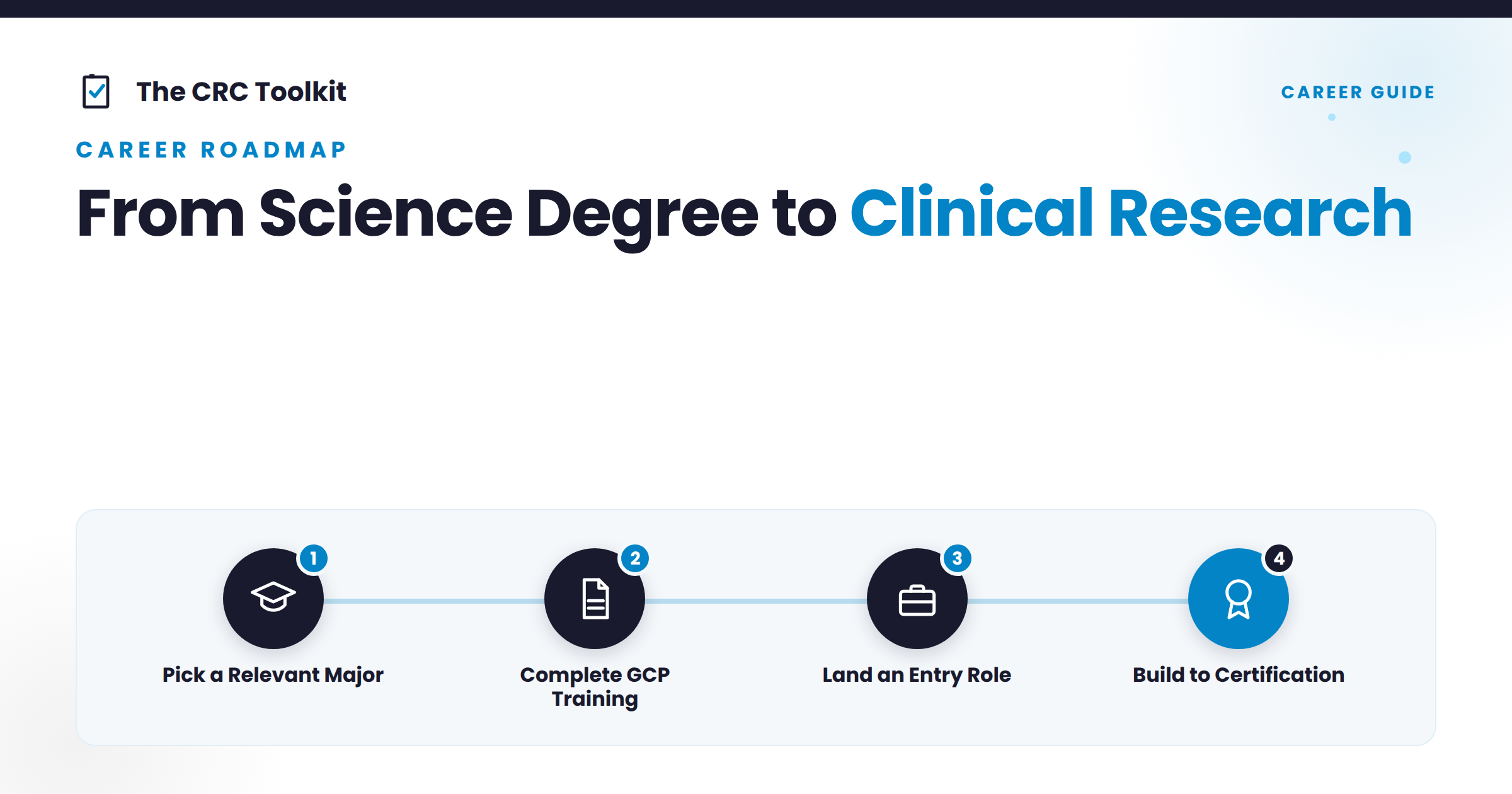
The path from science degree to clinical research role is achievable within a few months for well-prepared candidates. The following sequence reflects what that preparation looks like in practice.
First, complete GCP training and human subjects protection training. These credentials are the baseline qualification that every employer expects, and obtaining them before applying communicates genuine preparation. Document the certificates clearly — issuing organization, completion date, credential number if applicable.
Second, review ICH E6(R3) and at minimum Section 4 (Investigator) and Section 8 (Essential Documents). Reading the actual GCP guideline, even at a high level — gives you language, context, and regulatory grounding that almost no entry-level applicant brings to interviews. It takes two or three evenings and is one of the highest-leverage investments you can make.
Third, search ClinicalTrials.gov for trials being conducted at institutions in your area. Identify the specific sites running research in therapeutic areas that align with your academic background. Target those institutions directly on their careers pages. A cover letter that demonstrates you have identified specific active trials at the institution, noting study type, phase, and therapeutic area, is far more compelling than a generic application.
Fourth, target entry roles appropriately. Research Assistant, Study Coordinator I, Clinical Research Assistant, and Regulatory Coordinator are the right first positions for most science graduates. These are the roles designed for people at your level, and they are the established pathways to the Clinical Research Coordinator title.
The calculators on this site — visit window calculator, IP compliance calculator, date calculator — are the tools you will use from your first study day. Familiarize yourself with them now. Arriving at a new role knowing how to use the tools that experienced coordinators rely on is a small but meaningful signal of preparation.
Verified References & Primary Sources
- ICH E6(R3) — Good Clinical Practice Guideline — Finalized January 6, 2025. Qualification standard: education, training, and experience. Directly governs staff qualification requirements at clinical trial sites.
- FDA — Investigator Responsibilities: Protecting the Rights, Safety, and Welfare of Study Subjects — FDA guidance on the qualification standard for delegated tasks at clinical sites.
- 21 CFR Part 312 — Investigational New Drug Application — Federal regulations governing investigator qualifications, recordkeeping, and staff responsibilities.
- NIH/NIAID — Site Personnel Qualifications, Training and Responsibilities — NIH requirements for GCP and human subjects protection training for research staff.
- HHS — 45 CFR Part 46: Protection of Human Subjects — The Common Rule governing human subjects protections in federally funded research; relevant to IRB experience science graduates may bring.
- NIH — Clinical Research Trials: The Basics — NIH overview of the clinical research enterprise, including the role of IRBs and how trials are conducted across the NIH-funded research network.
- NIH — Definition of a Clinical Trial — Official NIH definition and stewardship requirements applicable to NIH-funded research at academic institutions.
- BLS — Occupational Outlook Handbook: Medical Scientists — 9% projected employment growth 2024–2034, $100,590 median annual wage (May 2024). Labor market context for clinical research careers.
- BLS — Employment Projections 2024–2034 Summary, Healthcare sector projected 8.4% growth, fastest of all sectors — driving demand for clinical research workforce.
- FDA — Diversity Action Plans for Clinical Studies — FDORA mandate creating new site-level responsibilities relevant to public health graduates and community health backgrounds.
- NIH — All of Us Research Program Enrollment Data — Via NCBI/NIH: program enrollment and diversity metrics relevant to community-engaged research roles.
Primary Sources & References
All factual claims in this article are verified against the following official regulatory and government sources:
- ICH E6(R3) Good Clinical Practice guideline
- Investigator Responsibilities
- 21 CFR Part 312
- mandate for diversity action plans
- NIH/NIAID site personnel qualifications guidance
- 45 CFR Part 46
- NIH's overview of clinical research
- NIH's clinical trial definition and stewardship requirements
- with over 786,000 participants enrolled to date, 46% diverse by race and ethnicity
- ClinicalTrials.gov
- BLS — Occupational Outlook Handbook: Medical Scientists
- BLS — Employment Projections 2024–2034 Summary