Adverse event reporting sits at the direct intersection of participant protection, data integrity, and regulatory compliance, and it is one of the most frequently cited deficiencies in FDA Bioresearch Monitoring inspections of clinical investigator sites. As a Clinical Research Coordinator, you are often the first person on the site team to learn about an adverse event: a participant mentions a new symptom during a visit, calls between visits to report a concern, or a laboratory result flags an abnormal value. What you do with that information in the hours that follow has regulatory consequences.
This guide covers adverse event reporting from its regulatory foundation, the specific federal regulations that define, require, and time AE and SAE reporting, through the practical documentation and workflow responsibilities of CRCs at the site level.
The Regulatory Basis for AE Reporting
Adverse event reporting in FDA-regulated clinical trials is grounded in two specific federal regulations that every CRC should know by citation.
21 CFR 312.32, IND Safety Reporting, defines adverse events, serious adverse events, and unexpected adverse events; establishes the reporting timelines for sponsors submitting IND safety reports to the FDA; and specifies the reporting format requirements. This regulation is the primary source of the definitions you use every day.
21 CFR 312.64, Investigator Reports, specifies the investigator's obligation to the sponsor: "An investigator must immediately report to the sponsor any serious adverse event, whether or not considered drug related, including those listed in the protocol or investigator brochure, and must include an assessment of whether there is a reasonable possibility that the drug caused the event." This is the regulation that makes SAE reporting to the sponsor a legal obligation of the investigator, not just a protocol requirement.
The ICH E6(R3) guideline, finalized January 2025, provides additional framework for how safety reporting obligations are implemented at the site level. Section 3.13 of E6(R3) covers investigator safety reporting responsibilities in detail. These ICH requirements are adopted as FDA guidance through the FDA's September 2025 publication of E6(R3) as final guidance. The underlying regulatory obligations flow from 21 CFR 312 — ICH provides the operational framework.
Core Definitions: AE, SAE, and Suspected Adverse Reaction
The first requirement for compliant AE reporting is precise understanding of the definitions. These terms are defined in federal regulation, not by convention, not by common usage, but by the text of 21 CFR 312.32(a).
"Any untoward medical occurrence associated with the use of a drug in humans, whether or not considered drug related." — 21 CFR 312.32(a)
This definition is intentionally broad. An adverse event does not require a causal relationship to the study drug. A participant who breaks their arm in a bicycle accident during study participation has experienced an adverse event. A common cold is an adverse event. A laboratory value that falls outside the normal range is an adverse event. If it is an untoward medical occurrence during study participation, it requires documentation and evaluation, the question of whether it is related to the study drug is a separate assessment, not a threshold for whether it qualifies as an AE at all.
"An adverse event or suspected adverse reaction is considered 'serious' if, in the view of either the investigator or sponsor, it results in any of the following outcomes: Death, a life-threatening adverse event, inpatient hospitalization or prolongation of existing hospitalization, a persistent or significant incapacity or substantial disruption of the ability to conduct normal life functions, or a congenital anomaly/birth defect. Important medical events that may not result in death, be life-threatening, or require hospitalization may be considered serious when, based upon appropriate medical judgment, they may jeopardize the patient or subject and may require medical or surgical intervention to prevent one of the outcomes listed in this definition." — 21 CFR 312.32(a)
"Any adverse event for which there is a reasonable possibility that the drug caused the adverse event. For the purposes of IND safety reporting, 'reasonable possibility' means there is evidence to suggest a causal relationship between the drug and the adverse event." — 21 CFR 312.32(a)
"An adverse event or suspected adverse reaction is considered 'unexpected' if it is not listed in the investigator brochure or is not listed at the specificity or severity that has been observed; or, if an investigator brochure is not required or available, is not consistent with the risk information described in the general investigational plan or elsewhere in the current application, as amended." — 21 CFR 312.32(a)
These four definitions form the classification framework for every AE you encounter. The combination of serious + unexpected + possibly related to the study drug is what creates a SUSAR, a Suspected Unexpected Serious Adverse Reaction, which carries the most urgent reporting requirements in the system.
SAE Seriousness Criteria under 21 CFR 312.32
21 CFR 312.32(a) defines an adverse event as serious if it meets any one of the following criteria. Meeting a single criterion is sufficient — the AE is treated as an SAE for reporting purposes regardless of how many criteria apply.
- Death: The adverse event results in the participant's death.
- Life-threatening: The event, in the view of the investigator or sponsor, places the participant at immediate risk of death. (Note: this means a real risk at the time of the event — not an event that could have been fatal if it were more severe.)
- Inpatient hospitalization or prolongation of existing hospitalization: The event requires or extends a hospital admission.
- Persistent or significant incapacity or substantial disruption of the ability to conduct normal life functions: A lasting impact on the participant's ability to function in daily life.
- Congenital anomaly or birth defect: The event results in a congenital anomaly or birth defect in a participant's offspring.
- Other important medical event: Any event that, based on medical judgment, may jeopardize the participant or require intervention to prevent one of the outcomes listed above. This category is exercised by the investigator and sponsor's medical monitor and exists so that medically important events that don't fit cleanly into the other five categories are still captured.
If any single criterion is met, the AE is serious and triggers SAE reporting obligations. Meeting multiple criteria does not make an SAE more serious — one criterion is sufficient.
⚠️ Serious ≠ Severe: The Most Common Confusion in AE Reporting
Severity and seriousness are independent assessments that must never be conflated. Severity describes the intensity of an adverse event on a spectrum from mild to severe. Seriousness is a regulatory classification based solely on whether any of the six seriousness criteria is met. A Grade 4 laboratory abnormality (severe by CTCAE criteria) is not an SAE unless it meets one of the six seriousness criteria. A Grade 1 hospitalization for observation, however brief and mild, is an SAE by definition because it meets the hospitalization criterion. These are separate questions. Always assess them separately.
The Four Required Assessments for Every AE
For every adverse event that occurs during a clinical trial, the investigator, with CRC support in documentation, must complete four independent assessments. These are defined by the protocol and ICH E6(R3) as essential elements of AE evaluation.
1. Severity Assessment
How intense is the adverse event? For most industry-sponsored trials, severity is assessed using the NCI Common Terminology Criteria for Adverse Events (CTCAE). For trials that do not use CTCAE, severity is assessed on a three-point scale: Mild (awareness of sign or symptom but easily tolerated), Moderate (discomfort sufficient to interfere with usual activity), or Severe (inability to perform usual activities). Always follow your protocol's specified severity grading system.
2. Seriousness Assessment
Does the AE meet any of the six seriousness criteria? This is a yes/no determination. If yes, the AE is an SAE and triggers the expedited reporting timelines. The seriousness assessment is independent of the severity assessment — assess both, and document both.
3. Relatedness Assessment
Is there a reasonable possibility that the study intervention caused or contributed to this event? Under 21 CFR 312.32(a), the standard for a "suspected adverse reaction" is whether "there is evidence to suggest a causal relationship." The investigator makes this assessment, not the CRC, but CRCs must understand the terminology used in the protocol's relatedness scale. Common terms include Not Related, Unlikely Related, Possibly Related, Probably Related, and Definitely Related. Some protocols use simplified two-category systems (Related/Not Related). Always use the scale specified in your protocol.
4. Expectedness Assessment
Is this adverse event listed in the Investigator's Brochure (IB) at the specificity and severity observed? Under the 21 CFR 312.32(a) definition, an adverse event is "unexpected" if it is not listed in the IB or is not listed at the specificity or severity that has been observed. Importantly, the regulation specifies that "hepatic necrosis would be unexpected (by virtue of greater severity) if the investigator brochure referred only to elevated hepatic enzymes or hepatitis" — the expectedness determination requires matching not just the general organ system but the specific presentation observed. The investigator makes this assessment in consultation with the current IB.
NCI CTCAE Severity Grading
The National Cancer Institute Common Terminology Criteria for Adverse Events (CTCAE) is the standardized grading system used in most oncology trials and increasingly in trials outside oncology. CTCAE provides a five-grade scale for specific adverse event terms, with defined descriptors for each grade. Understanding the grade structure is essential for CRCs working on trials that require CTCAE grading.
| Grade | General Description | Relationship to Seriousness |
|---|---|---|
| Grade 1 | Mild — asymptomatic or mild symptoms; clinical or diagnostic observations only; intervention not indicated | Not SAE based on grade alone |
| Grade 2 | Moderate — minimal, local, or noninvasive intervention indicated; limiting age-appropriate instrumental activities of daily life | Not SAE based on grade alone (may trigger SAE via hospitalization criterion) |
| Grade 3 | Severe or medically significant but not immediately life-threatening; hospitalization or prolongation of hospitalization indicated; disabling; limiting self-care activities of daily life | May trigger SAE via hospitalization or disability criteria |
| Grade 4 | Life-threatening consequences; urgent intervention indicated | Often triggers SAE via immediately life-threatening criterion |
| Grade 5 | Death related to AE | Always an SAE (death criterion) |
The CTCAE grade and the seriousness determination are separate — a Grade 3 event that requires hospitalization is both severe (Grade 3) and serious (hospitalization criterion). A Grade 3 event managed in an outpatient clinic without hospitalization may be severe but not serious. Always assess both independently and document both.
Reporting Timelines: The Regulatory Requirements
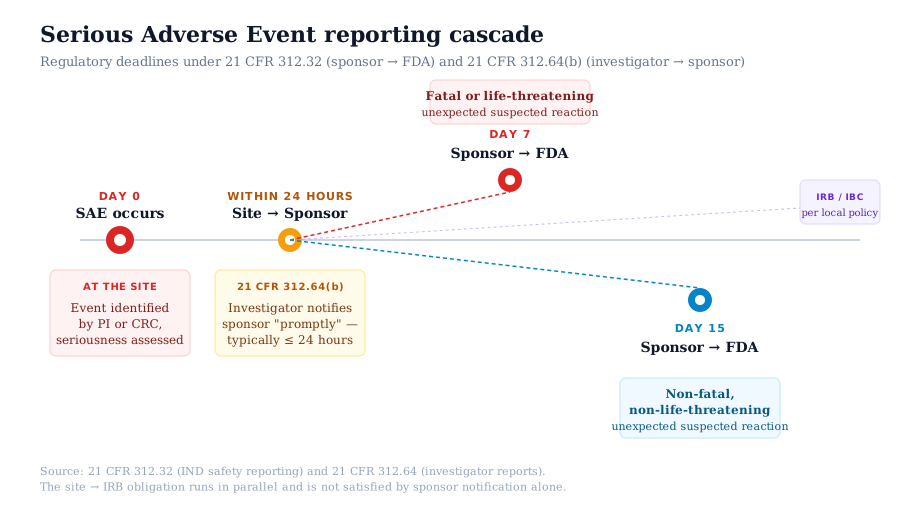
Reporting timelines in adverse event management are regulatory obligations, not protocol preferences. The clock starts from the moment the site team becomes aware, not from when the event occurred, and not from when the CRF is completed.
| Report | Timeline | Regulatory Basis |
|---|---|---|
| Initial SAE report to sponsor | Most protocols: within 24 hours of site awareness. Always follow your protocol's specific timeline. | 21 CFR 312.64(b) — "immediately report to the sponsor" |
| Follow-up SAE report to sponsor | Typically 5–7 calendar days from initial report (protocol-specific) | 21 CFR 312.32(c)(2) — follow-up must be submitted "as soon as available" |
| SUSAR (fatal/life-threatening) to FDA (sponsor obligation) | 7 calendar days from sponsor awareness | 21 CFR 312.32(c)(2) |
| SUSAR (all other) to FDA (sponsor obligation) | 15 calendar days from sponsor determination | 21 CFR 312.32(c)(1) |
| SAE notification to IRB | Varies by institution, typically 5–10 business days. Always check your IRB's specific requirements. | 21 CFR 56.108(b) — IRB continuing review of research |
| Non-serious AE to sponsor | Per protocol, typically at the next scheduled visit or within a defined window (e.g., 30 days) | 21 CFR 312.64(b) — per protocol timetable |
Calendar Days vs. Business Days
SAE reporting timelines under 21 CFR 312.32 are calendar days. They count weekends and holidays. If a participant calls to report an SAE on a Friday afternoon, your 24-hour initial report to the sponsor is due Saturday afternoon, and your 7-day follow-up is due the following Friday. Use the Date Calculator to compute accurate deadlines. The IRB timeline may be expressed in business days, verify your institution's specific requirement.
The Notification Chain: Who Reports What to Whom
The reporting chain in clinical trial safety management is a multi-party system, and understanding each party's specific obligation prevents gaps that become inspection findings.
Investigator → Sponsor: This is the primary site-level reporting obligation. Under 21 CFR 312.64(b), the investigator must immediately report any serious adverse event to the sponsor. This is an unconditional obligation — it applies "whether or not considered drug related" and regardless of whether the event appears in the IB. The initial report may be brief (what happened, when, current status); the follow-up must include the complete narrative, assessment of relatedness, and all relevant clinical details.
Sponsor → FDA: This is the sponsor's obligation under 21 CFR 312.32. The sponsor reviews all site SAE reports and determines whether any qualify as suspected adverse reactions that must be reported to FDA within the 7- or 15-day windows. The site's responsibility is to provide the sponsor with complete, accurate, timely information, not to second-guess the sponsor's determination of whether it rises to FDA reporting threshold.
Sponsor → All Investigators: Under 21 CFR 312.32(c)(1), when a sponsor submits an IND safety report, they must notify all participating investigators. This is the mechanism through which CRCs learn about SUSARs from other sites in the same study — essential safety information that may affect how you monitor your own participants.
Investigator → IRB: The investigator has an independent obligation to report SAEs to the IRB. This is governed by your institution's IRB policies and 21 CFR Part 56. The IRB timeline and required reporting format may differ from the sponsor's requirements, check both, and manage them separately. Some sites use a safety liaison role to manage IRB reporting; in others, the CRC manages both sponsor and IRB reporting workflows.
The CRC's Specific Role in AE Management
The clinical and regulatory assessments — severity grade, seriousness determination, relatedness, expectedness — belong to the investigator. The investigator must make these determinations and sign off on them. This is not the CRC's judgment to make, and substituting CRC assessment for investigator assessment is itself a delegation compliance issue under ICH E6(R3).
What CRCs own is the workflow that ensures the investigator can make those assessments correctly and on time. That workflow includes:
- First awareness documentation: When a participant reports a new event, by phone, during a visit, or through any other channel, document the date and time of your awareness immediately. This timestamp starts the reporting clock. It cannot be reconstructed accurately after the fact.
- Immediate PI notification: Any AE that could potentially be serious must be brought to the PI's attention immediately, not at the next convenient time, not at the end of the day. The 24-hour timeline leaves no room for delayed escalation.
- SAE form initiation: Many sites have SAE form templates. The CRC typically prepares the initial draft, drawing on the source record, medical history, concomitant medications, and the participant's account. The PI reviews, adds the clinical assessments, and signs.
- Follow-up tracking: An SAE report is not closed at the initial submission. The event must be followed to resolution or to a stable state, with follow-up reports submitted as new information becomes available. Tracking open SAEs is a core CRC responsibility.
- Source-to-CRF consistency: Every AE documented in source must be reflected accurately in the CRF. Discrepancies between the medical record and the CRF are among the most common findings on monitoring visits.
Source Documentation for Adverse Events
Under the ALCOA+ principles that govern clinical trial source documentation, every AE record must be: Attributable (who documented it), Legible, Contemporaneous (documented at the time of occurrence or awareness), Original, and Accurate — plus complete, consistent, enduring, and available.
A complete AE record in the source documents should capture: the date the site first became aware of the event; a description of the event in clinical terms; onset and resolution dates; the maximum severity grade reached; the investigator's relatedness assessment; action taken (e.g., dose reduced, study drug held, concomitant medication added, participant discontinued); current outcome status; and the PI's signature and date for the assessment.
For SAEs specifically, the source record must also capture the specific criterion that makes the event serious (which seriousness criterion), the date and time of the initial report to the sponsor, and the follow-up status at each subsequent contact. Some sponsors provide SAE narrative templates, these supplement but do not replace the source documentation in the medical record or study file.
Non-Serious AE Documentation
Non-serious adverse events, those that do not meet any of the six seriousness criteria, do not trigger the expedited reporting timelines, but they still require systematic documentation. They must be recorded in source, graded for severity, assessed for relatedness, and entered into the CRF according to the protocol's specified reporting window (typically at each study visit or within a defined collection period).
The practical risk with non-serious AEs is under-documentation rather than late reporting. Because they don't trigger the urgent escalation workflow, they can accumulate without adequate capture. Common failure modes include: not querying participants systematically about new events at each visit; omitting AEs that the CRC assessed as "clearly unrelated" before the investigator reviewed them; and failing to update AE records when previously reported events change in severity or resolve. Your protocol's AE collection section defines exactly which events must be captured — read it carefully, and follow the investigator's judgment, not your own, on what qualifies.
Edge Cases That Require Careful Judgment
Planned Hospitalizations
Not all hospitalizations during a study are SAEs. Most protocols include specific exclusions for planned procedures that were scheduled and documented before enrollment, a participant who has a knee replacement surgery that was planned and noted at screening is not necessarily experiencing an SAE when that surgery occurs. However, the exclusion requires specific documentation: the planned nature of the procedure must have been documented at screening. If there is any doubt about whether a hospitalization was truly planned, or if the hospitalization takes longer than expected or results in a complication — consult your PI before concluding no SAE report is needed. When in doubt, report.
Protocol-Specified SAE Exemptions
Many protocols explicitly exempt certain events from expedited SAE reporting when those events are the primary endpoints being measured — for example, all-cause mortality in a mortality-endpoint trial. Under 21 CFR 312.64(b), study endpoints that are SAEs must still be reported "in accordance with the protocol unless there is evidence suggesting a causal relationship between the drug and the event." If a mortality event also has evidence suggesting drug causation, it must be reported as an SAE even if it is a protocol-defined endpoint. Your protocol will specify this — read the SAE reporting section carefully for any endpoint-related exemptions and their conditions.
Pregnancies
Participant pregnancies are typically not AEs in themselves, but most protocols require immediate reporting to the sponsor because of the potential for fetal exposure to investigational product. Pregnancy is usually classified as a Special Situation requiring expedited reporting on the same or similar timeline as SAEs. Outcome of the pregnancy, including any congenital anomaly or birth defect — is a potential SAE. Check your protocol's specific pregnancy reporting section; it is almost always separate from the standard AE reporting section.
Events Occurring After the Last Protocol Visit
AE reporting obligations typically extend for a defined period after a participant's last protocol visit, a follow-up window specified in the protocol. Any serious adverse event occurring within that window that could be related to study participation must still be reported. The window is usually 30 days after the last dose of investigational product, but can vary. Know your protocol's post-study follow-up period.
The Most Common AE Reporting Errors
Based on FDA BIMO inspection findings and the most frequent monitoring visit observations, these are the AE-related documentation failures that appear most consistently.
- Late initial SAE reports: The clock starts at site awareness, not at the time the form is completed. Friday afternoon awareness means Saturday deadline. Never assume that a weekend event can wait until Monday.
- Missing follow-up reports: An initial SAE report without subsequent follow-up is incomplete. Follow every SAE to resolution, stable state, or end of study participation, submitting updates as new information becomes available.
- Conflating severity with seriousness: A severe event is not automatically an SAE. An SAE can be mild. Assess both independently on every event.
- Under-reporting from gatekeeping: CRCs who decide an event is clearly unrelated before the PI has assessed it are making a clinical judgment they are not qualified or authorized to make. Document first, escalate to PI, and let the investigator make the relatedness determination.
- Source-CRF discrepancies: The AE description in source and in the CRF must be consistent. Monitors specifically look for cases where the medical record contains AE information that was not entered in the CRF, or where the CRF records a different severity grade or onset date than the source.
- Incomplete source records: An AE source entry that captures only the event name and grade, without onset date, resolution date, relatedness, and action taken — is incomplete and will generate queries.
- IRB reporting gaps: Managing sponsor SAE reporting without separately tracking IRB reporting deadlines creates compliance gaps. The two chains are independent, a completed sponsor report does not satisfy the IRB notification obligation.
Verified References & Primary Sources
- 21 CFR 312.32 — IND Safety Reporting — The primary federal regulation governing AE definitions (AE, SAE, suspected adverse reaction, unexpected adverse event) and IND safety report timelines. The regulatory source for all definitions in this article.
- 21 CFR 312.64 — Investigator Reports — The federal regulation requiring investigators to immediately report SAEs to sponsors, regardless of relatedness. Establishes the site-level reporting obligation.
- 21 CFR Part 312 — Investigational New Drug Application — Full text of the IND regulations, including sponsor safety reporting obligations, investigator responsibilities, and record retention requirements.
- ICH E6(R3) — Good Clinical Practice Guideline — Finalized January 6, 2025. Section 3.13 covers investigator safety reporting responsibilities, including the updated SUSAR notification framework replacing the E6(R2) fixed timelines for investigator/IRB notification.
- FDA — E6(R3) Good Clinical Practice: Final Guidance — FDA's adoption of E6(R3) as final guidance, September 2025. Establishes E6(R3) as the current FDA framework for GCP implementation including safety reporting.
- 21 CFR Part 56 — Institutional Review Boards — Governs IRB continuing review obligations, including the requirement to review ongoing research including adverse event information.
- NCI CTCAE v5.0 — The National Cancer Institute Common Terminology Criteria for Adverse Events, the standard grading system used in oncology trials and many other therapeutic areas. Available free from the NCI Cancer Therapy Evaluation Program.
- ICH E2A — Clinical Safety Data Management: Definitions and Standards for Expedited Reporting — The ICH guideline establishing the 7- and 15-day SUSAR expedited reporting timelines for regulatory authority notification. The basis for the timeline requirements incorporated into 21 CFR 312.32.
Primary Sources & References
All factual claims in this article are verified against the following official regulatory and government sources:
- 21 CFR 312.32
- 21 CFR 312.64
- FDA's September 2025 publication of E6(R3) as final guidance
- 21 CFR Part 312 — Investigational New Drug Application
- ICH E6(R3) — Good Clinical Practice Guideline
- 21 CFR Part 56 — Institutional Review Boards
- ICH E2A — Clinical Safety Data Management: Definitions and Standards for Expedited Reporting