Consistency is the quiet advantage of a well-run clinical research site. When every SIV, every monitoring visit, and every daily rounds follows a repeatable pattern, deviations shrink, audit findings become rare, and coordinators stop losing evenings to preventable rework. The point of a good site checklist is not paperwork — it is a memory aid that offloads regulatory recall so you can focus on the judgment calls that actually require it.
This post introduces four free, downloadable checklists that cover the four moments that most reliably trip up busy CRCs: standing up a new protocol, running the daily site tempo, preparing for a monitoring visit, and documenting an issue in a Note to File. Each is available in both editable Word and print-ready PDF formats, and each is designed to be adapted to your site's SOPs.
Why Site Checklists Reduce Deviations
Every experienced CRC has seen the same failure mode play out: a competent coordinator, buried under three simultaneous protocols, misses a small step — the temperature log for one week, a specific consent form version dated one day off, a concomitant medication that never made it into EDC. The step itself is not complex. What failed was working memory under load.
Checklists solve this at the workflow level, and their value is well-documented in high-stakes clinical settings. The ICH E6(R3) guideline reinforces this by emphasizing a risk-proportionate, quality-by-design approach — sites are expected to build processes that are genuinely fit-for-purpose, not just responsive after the fact. Standardized site checklists are one of the cleanest ways to demonstrate that.
What Each Checklist Is (and Isn't)
These are working templates. They are opinionated starting points based on standard clinical research operations, not sponsor-specific SOPs. Every site has its own protocol requirements, EDC systems, and internal workflows — you should adapt each checklist to reflect your actual environment. Do not treat them as regulatory compliance certifications; treat them as scaffolding you customize.
1. Site Initiation Visit (SIV) Readiness Checklist
The Site Initiation Visit is the transition point from contracted-but-inactive to open-for-enrollment. Miss something at SIV and you inherit that gap for the entire study — regulatory documents that never quite caught up, systems access that has to be requested mid-visit, or an IP shipment sitting in a warehouse because IRT wasn't configured.
The SIV Readiness Checklist walks through the two categories most sites underestimate: pre-SIV essentials (informed consent and IRB status, contractual execution, regulatory documents, agenda circulation) and logistics and investigational product (IP accountability, equipment and lab preparation, systems access for every named staff member). Each item has a bold action title and a concise description of what "done" actually looks like.
Use this checklist the week before the visit, not the morning of. Regulatory document collection alone — current CVs, medical licenses, GCP training certificates for every listed staff member — routinely takes days when a certificate has expired or someone joined the study without updated training.
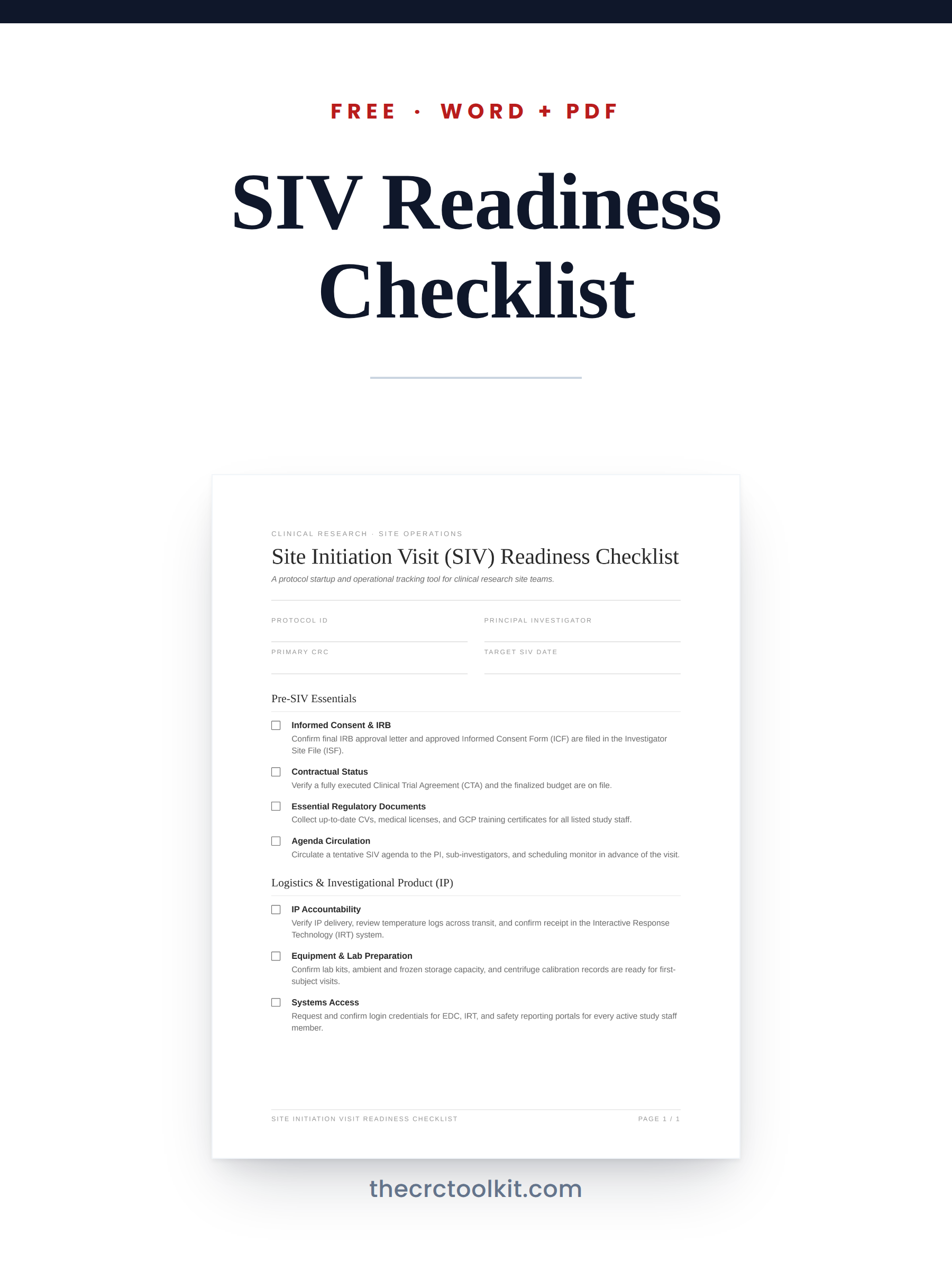
SIV Readiness Checklist
Editable Word (.docx) and print-ready PDF. One page, designed for the week before the visit.
Download Free →2. Daily CRC Checklist
The Daily CRC Checklist is the tempo document. It exists because the sheer number of small, time-sensitive tasks a working coordinator handles each day — temperature logs, EDC queries, AE follow-ups, protocol deviations, concomitant medication updates, IP accountability — will not stay reliably held in memory across weeks of study conduct. Reset your day with a checklist and you stop losing points on the small things.
The template is organized around four functional blocks:
- Morning Review: schedule and coverage confirmation, pre-visit chart review, and clearing yesterday's open items.
- Investigational Product, Lab & Specimens: temperature logs and lab kit / specimen shipment status.
- Visits, Source & Data: conducting visits per protocol, completing source documentation, EDC entry, and query resolution.
- Safety & Regulatory: AE / SAE review, concomitant medication log updates, and protocol deviation and regulatory filing.
The design goal was one page. A daily checklist that spans two pages is a daily checklist people stop reading by week three.
How to Actually Use a Daily Checklist Without Burning Out
Pick a fixed anchor moment — first coffee, before opening EDC, right after morning huddle — and run the checklist then. Do not attempt to check items throughout the day in an ad-hoc way; that reintroduces the same working-memory problem the checklist is meant to solve. Run it once at the anchor, and again in the last 15 minutes of the day for close-out items like source doc completion and regulatory filing.
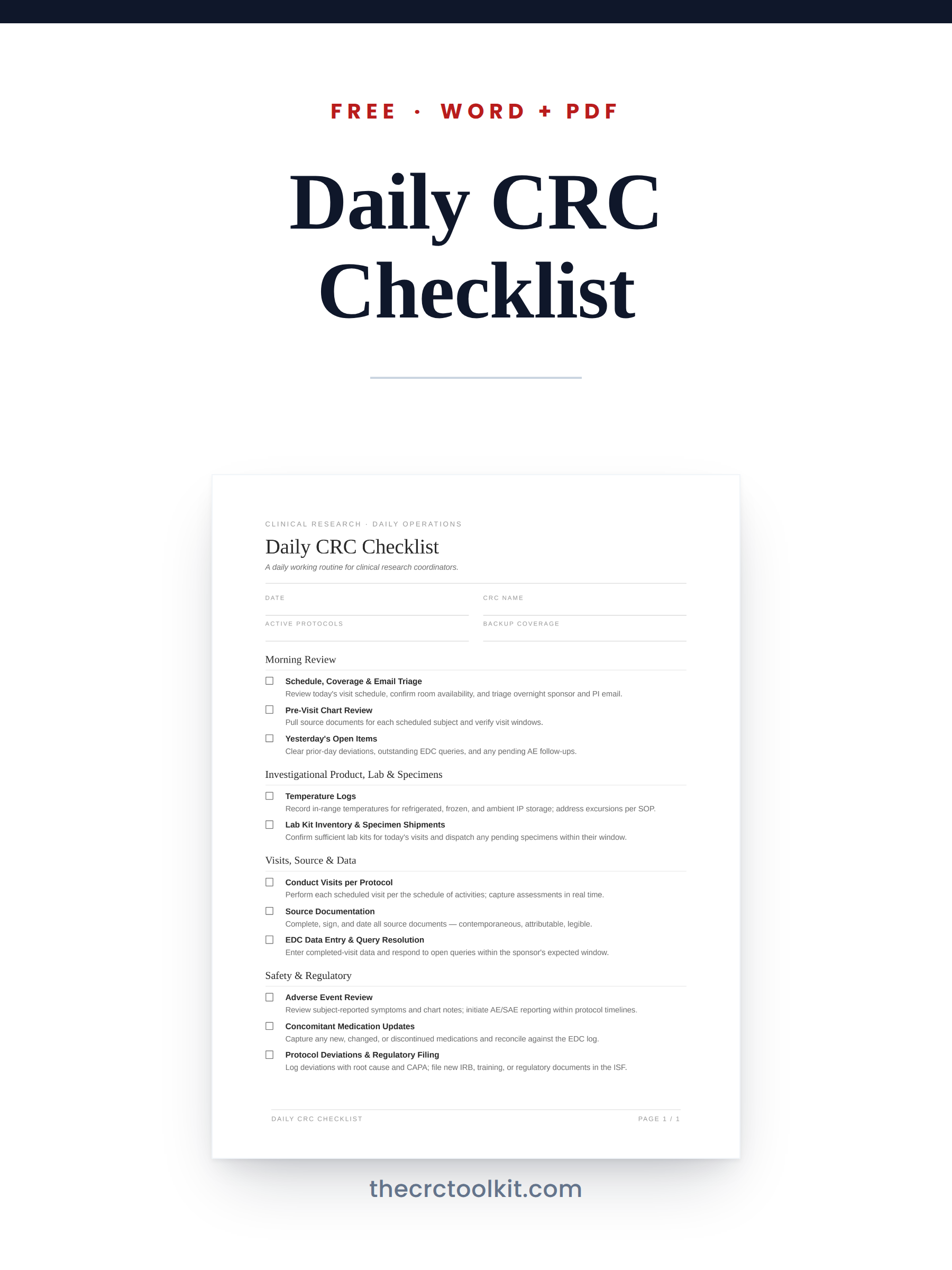
Daily CRC Checklist
Editable Word (.docx) and print-ready PDF. One page, designed to be run at a fixed anchor moment each day.
Download Free →3. Pre-Monitor Visit Source Review Checklist
Monitor visits go well when the site has already found and closed the issues the CRA would have flagged. The Pre-Monitor Visit Source Review Checklist is what that self-review looks like: a structured pass through the two areas monitors examine most closely — informed consent and subject eligibility, and data entry and safety alignment.
The consent and eligibility section verifies that each subject signed the current IRB-approved consent version before any study-specific procedure, and that concrete source documentation signed by the PI supports every inclusion and exclusion criterion. The data entry and safety section walks through EDC currency, adverse event alignment between chart notes and EDC log, and concomitant medication reconciliation.
Run this checklist per-subject in the days leading up to the visit. The alternative — hoping the monitor finds nothing — has a worse hit rate than most CRCs care to admit.
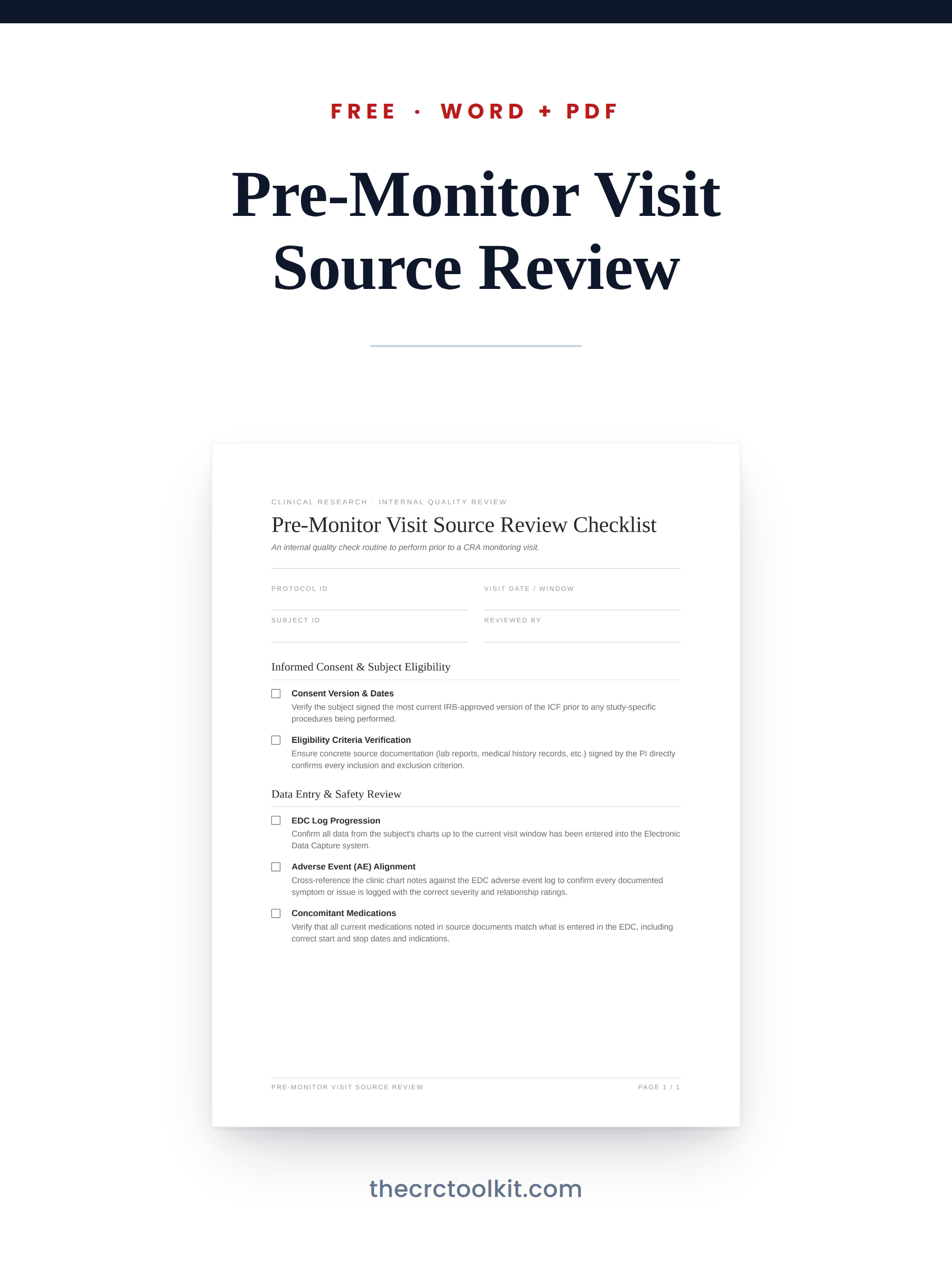
Pre-Monitor Source Review Checklist
Editable Word (.docx) and print-ready PDF. Run per subject in the days leading up to each CRA visit.
Download Free →4. GCP Note to File Template
A Note to File (NTF) is the documentation instrument used when something happens that the standard study documents cannot fully explain — a discrepancy discovered after the fact, an administrative correction, a clarification of a source document, an isolated deviation with a defensible root cause. Well-written NTFs support the trial master file; poorly written NTFs create more questions than they answer.
The template is structured to make writing a good NTF the path of least resistance. It captures the header information every NTF needs (protocol ID, date created, site number, subject ID if applicable, author name and title), then provides two dedicated writing blocks with in-place guidance:
- Issue / Discrepancy Description: objective facts, dates, and what precisely occurred — no interpretation.
- Root Cause & Corrective / Preventive Action (CAPA): why it happened, what was done immediately, and what prevents recurrence.
Signature blocks for the author and (where required) the PI are built in.
⚠️ What Makes an NTF Fail an Audit
The most common failure mode is not what people expect. It is not missing signatures. It is language that reads as if the author is defending the site rather than documenting what happened. NTFs should be neutral, factual, and specific. Words like "unfortunately," "obviously," "as everyone knows," and any editorial framing signal to an inspector that the document is a narrative rather than a record. Strip them out. State what happened, when, what was done, and what will prevent recurrence — nothing more.
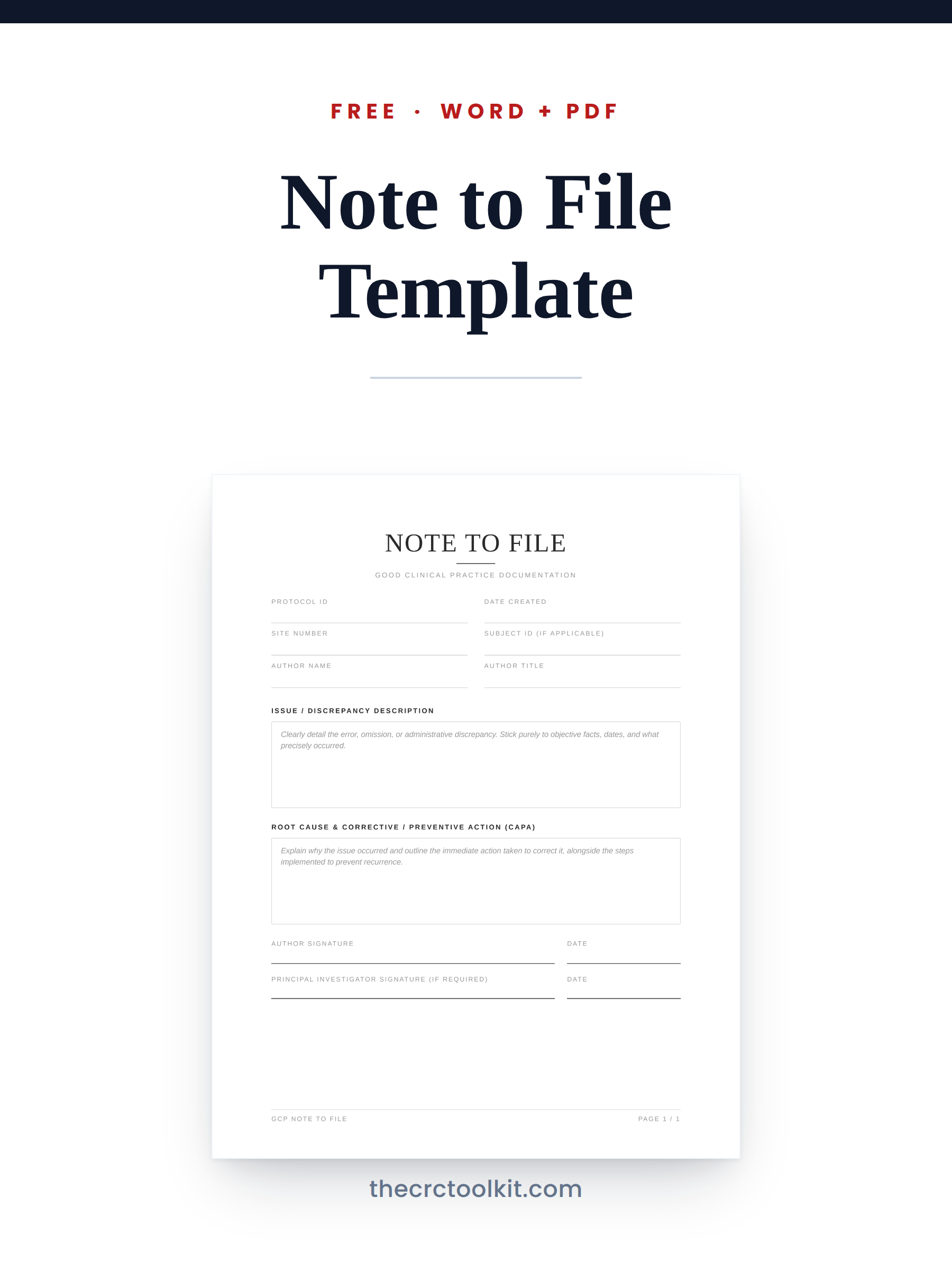
GCP Note to File Template
Editable Word (.docx) and print-ready PDF. Structured writing blocks with in-place guidance.
Download Free →How to Adapt These Templates at Your Site
Every site is different. A few practical suggestions for making these checklists genuinely yours:
Adapt the language to your SOPs. If your site refers to the ISF as the "Regulatory Binder" or the IP as "Study Drug," change the templates to match. Consistency between your working documents and your SOPs is more important than aesthetic preservation.
Add protocol-specific rows to the daily checklist. A visit-heavy oncology protocol needs different daily discipline than a device study with quarterly follow-ups. Add rows relevant to your studies rather than trying to make the general template fit every scenario.
Version-control them like SOPs. Once you have adapted a checklist, treat it as a controlled document — add a version and effective date to the footer, and store it in the location your team actually opens (a shared drive or protocol folder, not an inbox archive). A checklist nobody can find is a checklist nobody uses.
Do not use them as substitutes for training. A checklist supports a trained coordinator. It does not replace protocol training, GCP training, or hands-on mentorship. New CRCs should learn each item's regulatory why before relying on the checklist to remember the what.
Download All Four (Free)
All four checklists are hosted free on The CRC Toolkit shop. Both Microsoft Word (.docx) and PDF formats are available for each, so you can choose whichever fits your workflow.
If you have suggestions, or a checklist you would like to see added to the set, let us know — the toolkit grows based on what working CRCs actually need.