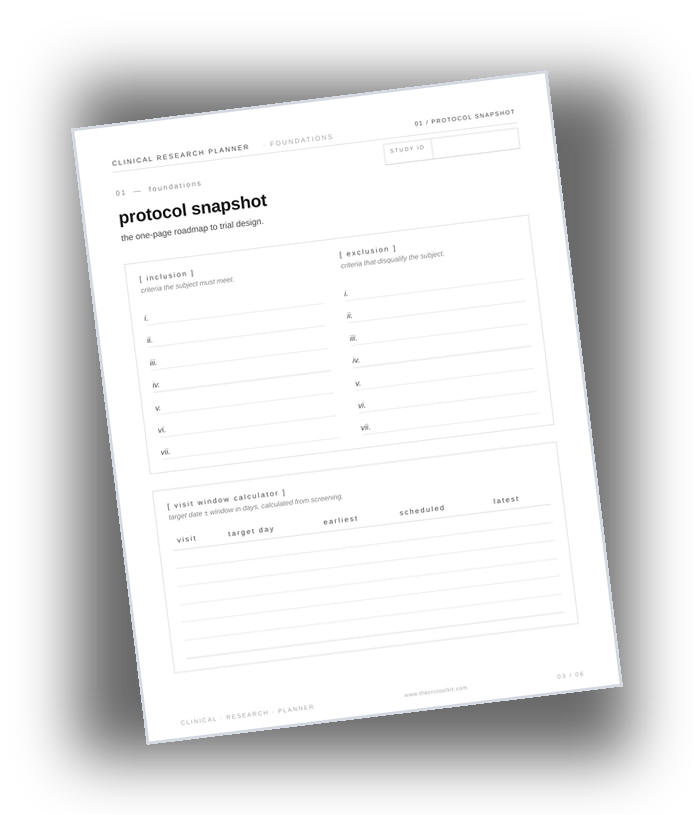
What Are Visit Windows in Clinical Trials?
A visit window is the range of acceptable dates within which a scheduled study visit may occur without constituting a protocol deviation. Every clinical trial protocol defines these windows, typically expressed as a number of days before or after the target visit date (e.g., "Visit 3: Day 28, ± 3 days"). The target date is usually calculated from a fixed anchor point, such as the date of the first dose, the date of enrollment, or a prior visit date, depending on the protocol's design.
Why Visit Windows Matter for Data Integrity
Clinical trials are designed with specific timing in mind. A pharmacokinetic sample drawn two days late may miss the drug's expected concentration peak. A tumor measurement obtained outside its window may be assessed at a point in the treatment cycle that doesn't reflect the protocol's intent. A visit that falls outside its window is a protocol deviation, which must be documented, assessed for clinical significance, and reported to the IRB if it meets the threshold for a major deviation.
Common Sources of Visit Window Deviations
- Scheduling from the wrong anchor: Always confirm your protocol's anchor point. Some studies count from Day 1 dosing; others count from the screening visit or a separate "Day 0" baseline. Using the wrong reference date shifts every subsequent window.
- Holidays and institutional closures: Proactively identify holidays that fall within visit windows early in the study. Shift visits to the beginning of windows rather than scrambling at the end.
- Patient no-shows and rescheduling: When a patient misses a visit, calculate the new acceptable window immediately. If you're already at the edge of the window, escalate to the PI — don't attempt a visit you already know is outside the window without sponsor or CRA guidance.
- Remote visit time zones: For remotely administered visits, confirm whether visit timing is based on the participant's local time or the site's time zone.
Best Practice: Build a Visit Schedule at Enrollment
When you enroll a new participant, spend 15 minutes populating a personalized visit schedule. Calculate every visit window from the anchor date, mark any that fall near holidays or the participant's known unavailability, and flag visits with narrow windows (e.g., ±1 day) for extra scheduling attention. Sharing this calendar with the participant at enrollment also improves adherence — participants who understand why their visit timing matters are more likely to prioritize it.
Deep Dive
Visit Window Compliance: Calendar Days, Anchor Dates, and the Protocol Deviation You Can Prevent
Visit window deviations are among the most common protocol deviations reported across clinical trial sites. They are also among the most preventable. Unlike adverse events that cannot be anticipated, visit window deviations almost always have a warning period. You can see them coming if you know where to look. Understanding how windows are calculated, what makes them binding, and how to manage the edge cases proactively is a core CRC competency.
The Regulatory Framework for Protocol Deviations
A visit that occurs outside its protocol-specified window is a protocol deviation. FDA's December 2024 draft guidance on protocol deviations defines a protocol deviation as any departure from the IRB-approved protocol, including departures from the schedule of assessments. Not all deviations are equal, the guidance distinguishes between important protocol deviations (those that may affect participant safety, data integrity, or the rights and welfare of participants) and minor deviations (those that are unlikely to have any of those effects).
Whether a given visit window deviation is important or minor depends on the visit's content. A missed window for a safety lab draw at a pharmacokinetically sensitive timepoint is more significant than a missed window for a routine follow-up questionnaire. Your site's classification should be discussed with the PI and the sponsor, and documented consistently across similar deviations within the study.
Calendar Days: The Default Standard
Clinical trial visit windows are specified in calendar days unless the protocol explicitly states otherwise. Calendar days count every day — Saturdays, Sundays, federal holidays, and institutional closure days all count. This is consistently the standard because trials are designed around biological timelines (drug half-lives, tissue recovery periods, tumor assessment intervals) that do not pause for the workweek.
The practical implication: a ±3-day window around a Day 28 visit gives you 7 total days of acceptable visit dates (Day 25 through Day 31). If Day 31 falls on a Sunday and your site is closed on Sundays, you cannot simply declare that Day 32 is acceptable because it's the next business day. The window closes on Day 31, full stop. This is why building the visit schedule at enrollment, before you discover a conflict the week before the visit, is so important.
Determining the Anchor Date: Where Most Errors Start
Every visit window is calculated from an anchor date. Getting the anchor wrong shifts every subsequent window in the study. The three most common anchor points, and the confusion they generate:
Day 1 = First Dose Date
In most interventional drug trials, Day 1 is defined as the date of first investigational product administration. Day 1 is not the date the patient signed consent, not the date of baseline assessments, and not the date of enrollment: it is specifically the first dose. If your patient received baseline assessments on a Monday and first dose on a Tuesday, Day 1 is Tuesday. A visit schedule built from Monday will be one day off for the entire study.
Day 1 = Screening or Baseline Visit
Some protocols, particularly device trials, observational studies, and studies involving a separate screening period — define Day 1 as the baseline visit date rather than the treatment date. Read your protocol's definition carefully. Look for language like "Day 1 is defined as the date of first study treatment" versus "Day 1 is the date of the baseline visit." If the definition is ambiguous, get written clarification from the sponsor before your first enrollment.
Rolling Windows from the Prior Visit
Some protocols define visit timing as a number of days from the prior visit rather than from a fixed anchor: "Visit 4 should occur approximately 28 days after Visit 3, ± 7 days." This design makes the anchor a moving target, if Visit 3 occurred at the edge of its window, Visit 4's window shifts accordingly. Document Visit 3's actual date at the time of the visit and calculate Visit 4's window from that actual date, not the target date.
When You're Already Outside the Window
If a participant presents for a visit and you calculate that today falls outside the protocol-specified window, the visit did not occur within the window, and conducting the visit does not fix that. The visit may still be conducted if the investigator determines it is in the participant's best interest and the sponsor concurs, but it will be recorded as a deviation. Do not calculate a visit window retroactively in a way that makes an out-of-window visit appear to be in-window. The actual date of the visit is the date in the source record — it cannot be adjusted.
The correct process: document the deviation promptly after identifying it, assess its clinical significance with the PI, report it to the IRB if it meets the threshold for an important deviation under your protocol's deviation reporting criteria per 21 CFR Part 56, and implement any corrective actions the sponsor requires.
The Proactive Approach: Managing Windows Before They Become Deviations
The most effective visit window management is forward-looking. At the time of each visit, calculate the acceptable window for the next visit and communicate it to the participant explicitly. Flag upcoming visits with narrow windows (±1 or ±2 days) in your tracking system so they receive proactive outreach, a reminder call two weeks before the window opens, not the day before it closes. For participants with known scheduling challenges (shift workers, frequent travelers, caregiving responsibilities), build the visit schedule around their constraints at enrollment, not reactively when a conflict arises.
Sources: FDA Draft Guidance — Protocol Deviations, December 2024 (
fda.gov); ICH E6(R3) Section 6 — Clinical Trial Protocol and Protocol Amendments (
ich.org); 21 CFR 312.62 — Investigator recordkeeping requirements (
ecfr.gov)