Job descriptions for Clinical Research Coordinators tend to read like a compliance document — "maintains regulatory files," "coordinates participant visits," "ensures protocol adherence." Technically accurate. Practically inadequate. The reality of the CRC role is more dynamic, more people-facing, and more intellectually demanding than any job posting captures. This is what the job actually looks like on a real day.
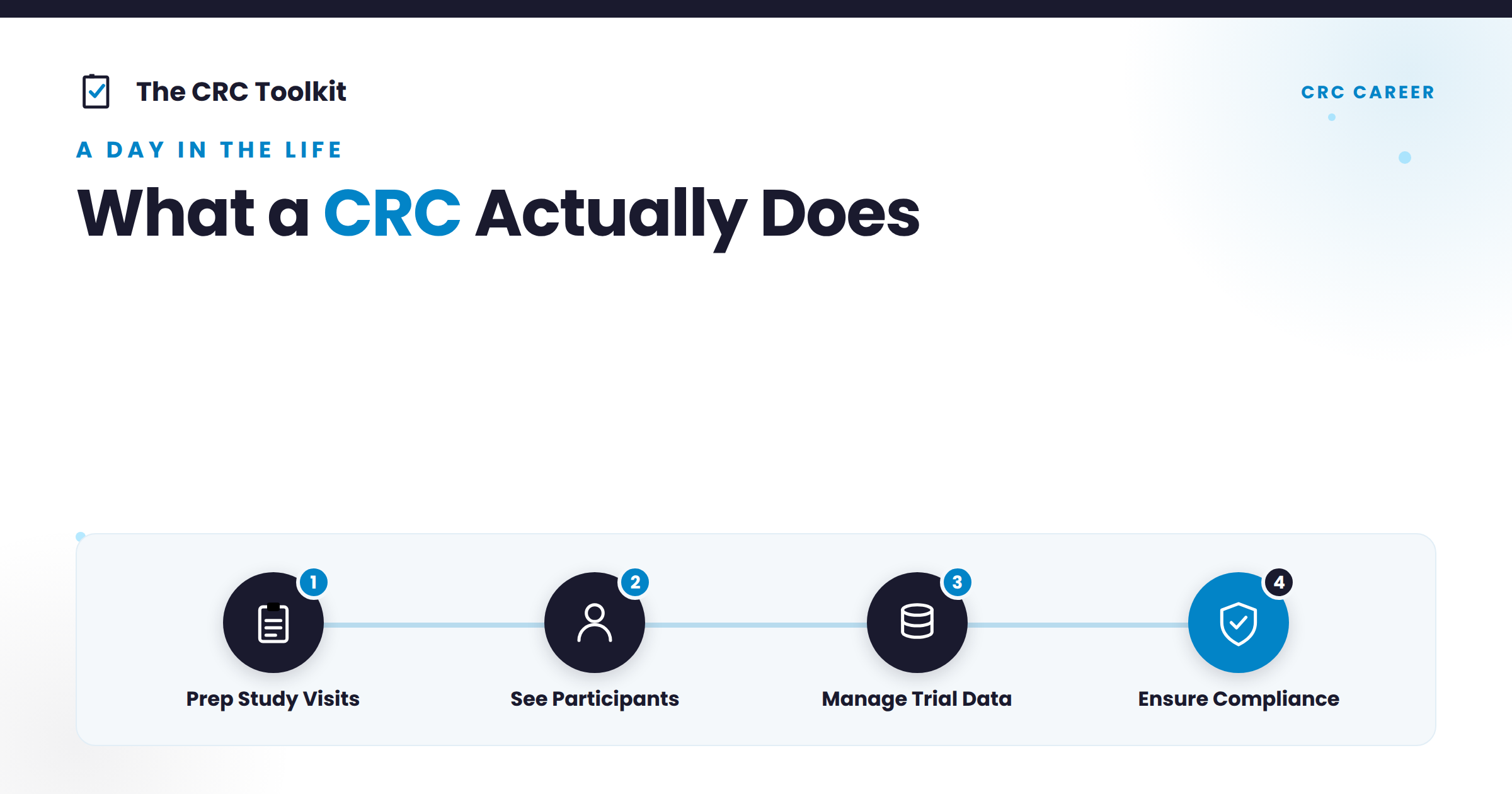
What a CRC Actually Does
At its core, the CRC role is the operational engine of a clinical trial site. The principal investigator provides medical oversight and makes clinical decisions; the CRC makes the trial happen day-to-day. This means managing the relationship with every enrolled participant, maintaining every regulatory document the trial requires, entering data that will eventually become part of a drug application, communicating with sponsors and CRAs, and ensuring that every participant interaction follows the protocol, not approximately, but exactly.
CRCs work on pharmaceutical, biotechnology, and device studies across every therapeutic area — oncology, cardiology, neurology, infectious disease, rare disease, and more. The specific procedures and participant populations vary enormously, but the role structure — participant management, documentation, data, regulatory compliance — is consistent across settings. A CRC at an academic medical center coordinating Phase I oncology trials and a CRC at a community research site running Phase III cardiovascular studies are doing fundamentally the same job in very different clinical environments.
Most experienced CRCs manage multiple active studies simultaneously — five to ten protocols is common at busy sites, though the number varies widely by therapeutic area complexity and site type. This means any given day involves multiple protocols, multiple sponsor systems, and participants at different stages of different studies, all governed by different protocol requirements.
Morning: Before the First Participant Arrives
Before the first participant walks in, a well-prepared CRC has already reviewed every visit scheduled for the day. This means pulling the visit schedule, confirming which participants are coming in and for which study visits, verifying that all required procedures for each visit are accounted for, and checking that consent versions are current for anyone whose consent may have been updated since their last visit.
For studies that require advance lab processing — kits that need to be assembled, samples that need to be pre-labeled, temperature materials that need to be staged, this is the time to set them up. A participant who arrives for a pharmacokinetic sampling visit requiring nine timed blood draws at specific intervals cannot wait while you find the sample tubes. The prep work happens before they arrive, not during the visit.
The morning review also includes a check of any outstanding issues from previous visits: open CRF queries, unresolved AE follow-ups, pending sponsor communications. The goal is to walk into clinic with a clear picture of what each visit requires and nothing hanging from yesterday that needs to be resolved today.
This is also when the CRC checks email and messages. Sponsors, CRAs, and trial managers often communicate overnight — protocol questions, safety notifications, monitoring visit requests, query responses. Triaging this communication before clinic begins prevents inbox overload during the visit window when participant-facing time should be protected.
Clinic: The Visit Window
The visit itself is where the protocol meets the participant. For a typical interim study visit, the CRC is managing the entire clinical encounter: greeting the participant, reviewing their interval medical history since the last visit, asking about any new medications or adverse events, pulling up their prior CRF data to check whether any pending items need follow-up, and walking them through all the protocol-required procedures for that visit.
Depending on the study and the site's delegation structure, the CRC may be performing the procedures directly — vital signs, ECGs, questionnaire administration, study drug dispensation and counseling, or coordinating with other team members: drawing blood for the lab, escorting the participant to imaging or pharmacy, and ensuring the PI reviews any clinical findings that require medical assessment.
The consent review is part of every visit, whether explicitly acknowledged as such or not. Is this participant still on the correct consent version? Have there been any protocol amendments since they enrolled that required re-consent? Is there anything about their presentation today, a new symptom, a new medication, a concern they mention, that suggests something needs to be escalated to the PI?
Visit notes are written contemporaneously — during or immediately after the visit, not hours later. Under ALCOA+ principles as codified in ICH E6(R3), contemporaneous documentation is one of the core data quality requirements, and reconstructed visit notes written from memory at the end of the day are a source documentation weakness that monitors and inspectors will note. The discipline of writing the note while the visit is still fresh, or immediately after the participant leaves, is one of the habits that distinguishes experienced CRCs from newer ones.
The Protocol Is the Standard, Not the Checklist
The most effective CRCs don't just follow visit checklists. They understand the protocol well enough to catch when something doesn't fit. A participant who mentions a new symptom that sounds like an AE but isn't on their checklist; a lab value that falls just inside the normal range but represents a meaningful change from baseline; a visit that falls at the outer edge of its window. Understanding why the protocol requires what it requires is what enables the judgment calls that no checklist can anticipate.
Between Visits: The Gaps That Fill Quickly
The time between clinic visits is rarely quiet. A participant leaves at 9:45; the next one arrives at 10:30. That 45-minute window contains: entering the morning's AE updates into the EDC before the next participant arrives; calling the lab to follow up on a specimen that didn't result in time for today's review; responding to a CRA's email about a query; updating the IP accountability log to reflect this morning's dispensation; and printing and filing the visit note.
Participant phone calls fall here too. CRCs regularly communicate with study participants between visits — participants calling to report a new symptom, confirm their next appointment, or ask whether they can take a new over-the-counter medication. These calls are not informal conversations; they are part of the evidentiary record. Any AE, new medication, or relevant medical information reported in a call must be documented in the source as a phone contact note, with the date, time, what was discussed, and any follow-up action taken.
Data Entry: The Invisible Work That Validates Everything
Data entry into the EDC (electronic data capture) system is where the morning's clinical work becomes regulatory data. Every value recorded in source — vital signs, lab results, AE descriptions, visit dates, procedure completions — must be transcribed to the CRF accurately and on time. Most protocols specify data entry windows: data must be entered within a defined number of days of the visit or event.
The standard for data entry is not just accuracy: it is concordance with source. The value in the CRF must match the value in the source document exactly. Date formats, units of measure, and clinical terminology must be consistent. When a monitor performs SDV, they are comparing CRF to source line by line. Every discrepancy generates a query; every query requires a response and additional documentation.
Query management — responding to data queries generated by the sponsor's data management team or by the CRA during monitoring — is a continuous part of the workload. Queries ask the site to explain, correct, or provide additional documentation for data that appears incomplete, inconsistent, or unclear. High-quality data entry generates few queries. A site with chronic query backlogs signals poor data management and creates significant extra work that compounds over time.
The Unexpected: What Changes the Day
Anyone who has worked as a CRC knows that the scheduled day rarely survives contact with reality. The participant who arrives for a routine visit and mentions chest pain that started last night. The laboratory result that comes back flagging a Grade 3 value for a participant you saw this morning. The sponsor email that arrives at 2 PM notifying you of a new IND safety report that requires immediate participant review. The IRB approval that expires in three days and needs an emergency continuing review submission under 21 CFR Part 56.
SAE identification and response is the highest-priority unexpected event in the CRC's day. Under 21 CFR 312.64(b), serious adverse events must be immediately reported to the sponsor. "Immediately" in practice means as soon as you are aware, not when it is convenient, not at the end of the day, not after you have completed your other tasks. A participant who discloses an SAE at 3 PM on a Friday afternoon starts a 24-hour reporting clock that runs through the weekend.
The ability to handle the unexpected without allowing it to derail the planned work is one of the core competencies of an experienced CRC. This means knowing which escalations are urgent and which can wait for the next business day, having clear communication with the PI about when their input is needed immediately versus at the next convenient time, and being able to pivot without losing track of what else needs to be completed.
End of Day: The Wrap
The end of a clinic day involves confirming that every visit note from the day is written, signed, and filed. Every sample drawn today is accounted for — submitted to the lab, results pending, or received and filed. The IP accountability log reflects every dispensation from today's visits. Any AEs identified or updated today are entered in the EDC or flagged for entry tomorrow within the protocol's data entry window. Any open SAE reports from today have been initiated and sent to the PI for review.
Tomorrow's visit schedule is reviewed: who is coming in, what procedures are required, what needs to be prepped. The visit window calculator is checked for any participants whose upcoming visits are approaching the edge of their allowed window — proactive reminders go out now, not when the window is about to expire.
Files are put away and access controls confirmed. Study documents, consent forms, source records, IP logs, are secured in their designated locations. Any sponsor communications from the day that require follow-up are flagged.
A No-Clinic Day: The Behind-the-Scenes Work
Not every CRC day involves participant visits. Days without scheduled visits are when the infrastructure work happens, the work that enables clinic days to run smoothly.
ISF maintenance: filing new documents, updating the delegation log when a staff change has occurred, checking that IRB approvals and GCP certificates are current. Regulatory correspondence: reviewing and responding to monitoring visit letters, preparing protocol deviation reports, drafting re-consent materials for an upcoming amendment. Protocol review: a new protocol amendment arrived this week and needs to be read, understood, and discussed with the PI before the sponsor's training call next Tuesday. Screening and recruitment: calling potential participants identified through chart review, conducting phone pre-screenings, scheduling eligibility assessments.
On multi-study sites, no-clinic days for one study are often clinic days for another. The rhythm of the week is determined by the study schedules across all active protocols, and experienced CRCs develop a weekly planning structure that ensures no study's administrative work is consistently deferred to the bottom of the pile.
What Makes the Job Hard
The hardest part of clinical research coordination is not the complexity of any individual task: it is managing the simultaneous demands of multiple active studies, each with its own protocol requirements, sponsor expectations, participant schedules, and regulatory obligations, without dropping anything important.
The documentation discipline required is relentless. Every interaction, every procedure, every clinical observation must be documented contemporaneously, accurately, and in a way that a reviewer who was not present could use to reconstruct what happened. This discipline does not come naturally to everyone and has to be actively cultivated: it is easy to tell yourself you will write the visit note after one more task, and then find that "after one more task" has become the end of the day.
The participant relationship has its own weight. CRCs often know their study participants well — long-term studies mean regular contact over months or years. Participants share personal information, health challenges, and vulnerabilities in ways they may not share with their regular care team. When a participant deteriorates, or when an SAE occurs, or when a participant decides to withdraw — the CRC feels these outcomes in ways that require professional and personal resilience.
And the regulatory landscape changes. ICH E6(R3) replaced E6(R2) in 2025. The FDA published a new protocol deviations guidance in December 2024. Certification requirements update. EDC systems change. Staying current is not optional: it is part of the job.
What Makes It Rewarding
Most CRCs stay in the field because the work is genuinely meaningful. Every study you coordinate is contributing to an evidence base that will, if the drug works, if the device is safe, if the intervention is effective — eventually help patients who are not yet in clinical trials. The CRC is the person who makes sure that contribution is valid: that the data is credible, that the participants were protected, that the protocol was followed. That is not a small thing.
The intellectual engagement is real. Understanding a Phase I oncology protocol well enough to coordinate it requires genuine scientific literacy. Managing the regulatory complexity of a multi-study site requires genuine compliance expertise. Navigating participant relationships in the context of serious illness requires genuine interpersonal skill. The CRC role asks for all of these simultaneously, and the people who thrive in it generally do so because they find that combination engaging rather than overwhelming.
And the field offers genuine career mobility. CRCs who develop strong protocol expertise and regulatory knowledge move into clinical research management, CRA roles, regulatory affairs, data management, and trial leadership positions at sponsors and CROs. The role is a foundation for a broad career, not a terminal position.
The Tools CRCs Use Daily
The specific systems vary by site, but the categories are consistent:
- Electronic Data Capture (EDC): Medidata Rave, Oracle Inform, Veeva Vault EDC, REDCap, the system where CRF data is entered, queries are managed, and data is submitted to the sponsor
- Electronic Medical Records (EMR): Epic, Cerner, or other hospital-based systems that often contain source data for study participants enrolled from clinical care
- Regulatory/ISF platforms: Electronic TMF systems like eTMF, Veeva Vault eTMF, or sponsor-provided platforms for essential document management
- Calculators and date tools: Visit window calculators, IP compliance calculators, CrCl calculators — see the CRC Toolkit calculators for free browser-based tools designed for this purpose
- Sponsor portals: Most sponsors have study-specific portals for safety communications, protocol documents, and training
- IRB portals: Institutional or centralized IRB platforms for submissions, continuing reviews, and safety reporting
Regulatory References
Primary Sources & References
All factual claims in this article are verified against the following official regulatory and government sources: