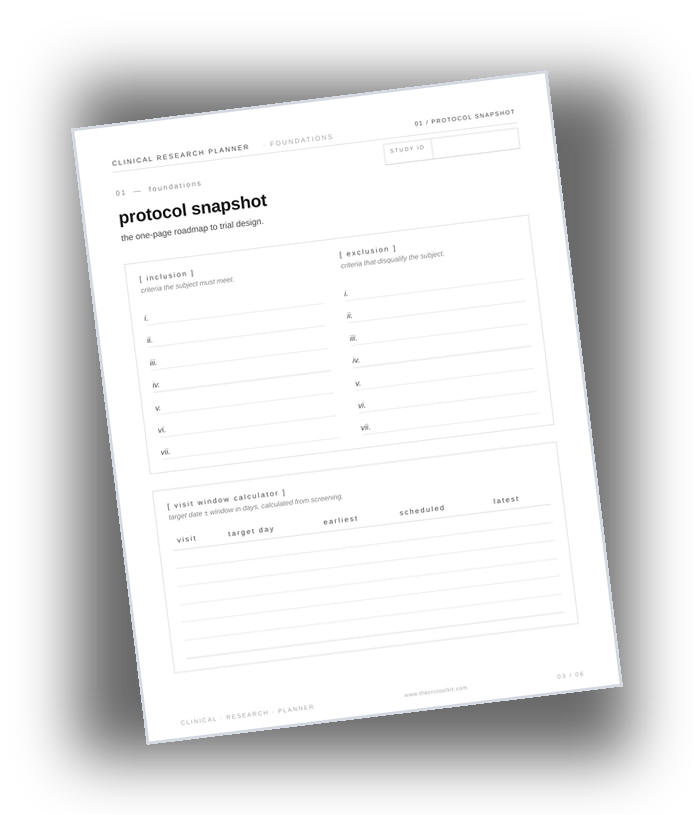
Why Date Arithmetic Is Critical in Clinical Research
Clinical trials run on dates. Enrollment eligibility windows, informed consent expiration, adverse event reporting timelines, protocol amendment effective dates, regulatory submission deadlines, all of these depend on accurate date calculations. A single day's error in a critical timeline can mean the difference between a compliant activity and a protocol deviation, a reportable event and a missed safety report, or an eligible participant and an unnecessary screen failure.
Key Research Timelines That Require Date Calculations
- Adverse Event Reporting: ICH E6 and most protocols require SAEs to be reported to the sponsor within 24 hours of the site becoming aware, with follow-up reports often due within 7 calendar days.
- Protocol-Required Lab Windows: Many protocols require baseline labs to be drawn within a defined period before the first dose (e.g., "within 7 days of Day 1").
- ICF Expiration: When a protocol amendment changes the informed consent document, participants must re-consent before their next visit. Calculate re-consent deadlines from the IRB approval date of the amendment.
- Study Drug Expiration: Calculate the expiration date from lot-specific data to ensure drug is not dispensed past its shelf life, a direct participant safety concern.
- Regulatory Submission Deadlines: IRB continuing reviews, annual FDA reports, and sponsor-required milestone reports all have fixed calendar-day deadlines from anchored dates.
Calendar Days vs. Business Days
Most clinical trial timelines, particularly safety reporting deadlines are specified in calendar days, not business days. This means weekends and holidays count. The 24-hour SAE reporting clock does not pause on Saturday. Always clarify with your protocol whether a timeline uses calendar or business days, and when in doubt, treat it as calendar days. This calculator uses calendar days; if your protocol specifies business days, you will need to manually adjust for weekends and holidays.
Deep Dive
The SAE Reporting Clock: 24 Hours, 7 Days, 15 Days — What Each Deadline Means and When It Starts
Serious adverse event reporting is the highest-priority time-sensitive obligation in clinical research. Unlike visit windows, where a narrow miss is a documentation problem — missing an SAE reporting deadline is a regulatory violation with direct implications for participant safety oversight across the entire study program. The reporting clock runs continuously, including weekends and holidays, and it starts the moment your site becomes aware, not when you finish your investigation, not when the PI has reviewed the case, and not at the start of the next business day.
The Regulatory Framework: 21 CFR 312.32
21 CFR 312.32 establishes the sponsor's IND safety reporting obligations. Under 312.32(c)(1), sponsors must report to FDA any serious and unexpected suspected adverse reaction that is fatal or life-threatening within 7 calendar days of initial receipt of the information, with a follow-up report within 15 days containing full details. All other serious and unexpected suspected adverse reactions must be reported within 15 calendar days.
The investigator's obligation is established at 21 CFR 312.64(b): the investigator must immediately report any serious adverse drug reaction to the sponsor. This is a legal obligation, not just a sponsor requirement. ICH E6(R3) Section 2.7 further specifies the GCP framework for investigator safety reporting. "Immediately" in FDA's context means as soon as reasonably possible — in practice, most sponsors define this as within 24 hours of site awareness in their study-specific SAE reporting procedures. Your sponsor's protocol or SAE reporting manual governs the site-level timeline; 21 CFR 312.64 governs the minimum standard.
When Does "Aware" Start the Clock?
The reporting timeline begins when any member of the site team becomes aware of an event that may constitute a serious adverse event, not when the PI has reviewed and confirmed it, not when source documentation is complete, and not when the SAE form has been filled out. If a participant calls the study coordinator on a Friday evening to report a hospitalization that began Thursday, the site's awareness is Friday evening. The clock has started.
This "awareness" standard creates practical challenges for sites. You do not need to have all the information to begin the reporting process. You report what you know and follow up with additional details as they become available. An initial SAE report with incomplete information submitted on time is far preferable to a complete report submitted late. Most sponsors have specific procedures for submitting initial reports flagged as "incomplete — follow-up to follow."
The Three Reporting Deadlines You Need to Know
24 Hours — Site to Sponsor
Most sponsor SAE reporting procedures require site notification within 24 hours of site awareness. This is the site's primary obligation. The notification typically requires completion of a sponsor-specific SAE report form or entry into the sponsor's safety database. Even if complete information is not yet available, initial notification must occur within 24 hours. The follow-up report with complete information is typically due within 5–7 calendar days of initial notification, per sponsor requirements.
7 Calendar Days — Sponsor to FDA (Fatal/Life-Threatening Only)
Under 21 CFR 312.32(c)(1)(i), fatal or life-threatening serious unexpected adverse reactions must be reported by the sponsor to FDA within 7 calendar days of the sponsor's initial receipt of information. This is a sponsor obligation, not a direct site obligation, but the site's 24-hour notification requirement exists specifically to give the sponsor sufficient time to meet their own 7-day FDA deadline.
15 Calendar Days — Sponsor to FDA (All Other Serious Unexpected)
All other qualifying serious and unexpected adverse reactions — hospitalizations, persistent significant disability, important medical events — require sponsor-to-FDA reporting within 15 calendar days of initial receipt. Again, the site's prompt notification enables the sponsor to meet this deadline.
Counting the Days: A Common Calculation Error
Day counting in SAE reporting follows a specific convention that is easy to misapply. The day of awareness is Day 0, not Day 1. The 24-hour deadline falls at the end of Day 1 (24 hours after the moment of awareness). The 15-day deadline falls at the end of Day 15 (counting from Day 0).
Example: site becomes aware of a hospitalization at 4:00 PM on a Monday. Day 0 is Monday. Day 1 is Tuesday. The 24-hour reporting deadline is 4:00 PM Tuesday (24 hours from awareness). The 15-day deadline is 4:00 PM on the Sunday two weeks later. These deadlines do not pause for weekends, holidays, or site closures.
IRB Notification: A Parallel Obligation
In addition to sponsor notification, sites have IRB reporting obligations for certain serious adverse events under 21 CFR Part 56. Most IRBs require expedited reporting of unanticipated problems involving risks to participants or others, a category that often includes serious adverse events that are unexpected and possibly related to the study intervention. Your IRB's reporting requirements and timelines are specified in the IRB's policies and in the study's IRB-approved protocol. These timelines run in parallel with sponsor reporting and are not satisfied by the sponsor notification alone.
Annual IND Safety Report Dates
Under 21 CFR 312.33, sponsors must submit annual reports to their IND within 60 days of the anniversary of the IND's effective date. For sites, this means being responsive to sponsor requests for site-specific safety data summaries during annual report preparation periods. For sites, this means being responsive to sponsor requests for site-specific safety data summaries during annual report preparation periods. Know your study's IND anniversary date if the sponsor has shared it — it predicts when you may receive urgent data requests.
Sources: 21 CFR 312.32 — IND Safety Reporting (
ecfr.gov); 21 CFR 312.64(b) — Investigator safety reporting obligations (
ecfr.gov); 21 CFR 312.33 — Annual IND reports (
ecfr.gov); ICH E6(R3) Section 2.7 — Safety reporting obligations under GCP (
ich.org)