Clinical research is genuinely difficult to break into, not because the work requires credentials that take years to accumulate, but because the field has a structural entry problem: even junior roles list "prior clinical research experience" as a requirement, and the most common question from aspiring coordinators is a version of the same thing. How do you get experience if you can't get hired without experience?
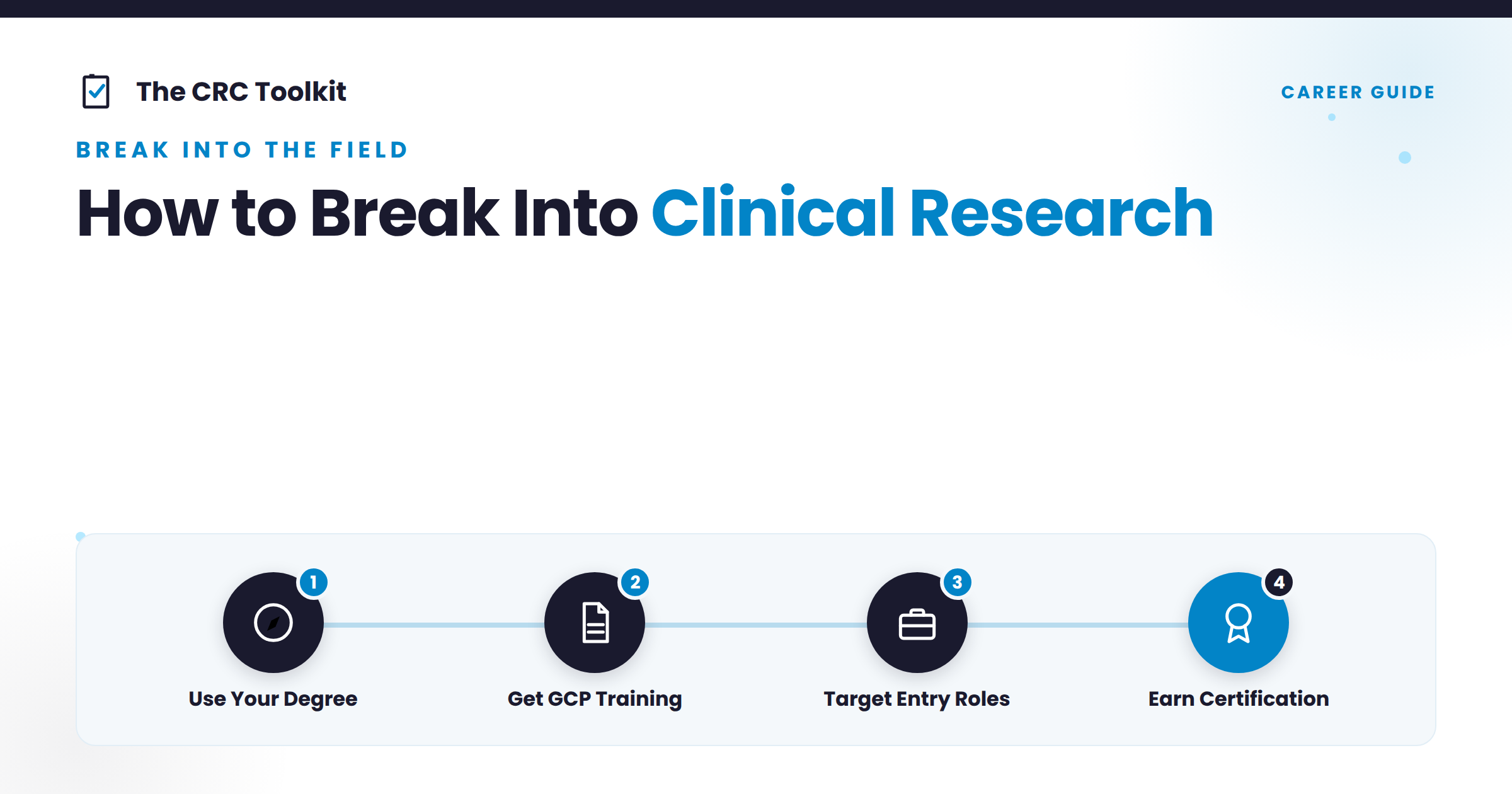
The answer is not to wait until you have exactly the right resume. It is to understand precisely what the field actually requires — what the regulatory framework specifies, what hiring managers are actually trying to screen for, and where genuine alternative pathways exist. This guide is built on official sources rather than general advice. It draws directly from the regulatory qualifications framework in ICH E6(R3), BLS labor market data, and FDA guidance, because understanding what the regulations actually say about qualifications is the most direct route to a realistic strategy.
The 2026 Labor Market Context
The macro backdrop for entering clinical research is favorable. According to the U.S. Bureau of Labor Statistics 2024–2034 Employment Projections, healthcare and social assistance is projected to be the fastest-growing and largest job-adding sector in the economy over the coming decade — an 8.4% increase driven by an aging population and growing rates of chronic disease. The demand for new treatments that drives this growth is directly upstream of clinical research employment.
Specifically, the BLS Occupational Outlook Handbook for Medical Scientists projects 9% employment growth from 2024 to 2034, three times the average for all occupations, with approximately 9,600 openings projected per year. The median annual wage for medical scientists was $100,590 in May 2024. These figures represent the broader research scientist category; CRC-specific roles tend to sit below this median at entry level, with significant progression potential as experience and credentials accumulate.
The structural change driving new entry-level demand in 2026 specifically is the FDA's September 2024 final guidance on decentralized clinical trials. As trials increasingly incorporate remote and hybrid elements, home visits, local lab draws, telehealth follow-ups, sites need staff who can manage more distributed operational workflows. This has expanded the types of support roles available at the entry level, particularly at sites that are building out DCT infrastructure.
What Actually Qualifies Someone for Clinical Research Work
The single most important thing to understand about entry-level clinical research qualifications is what the governing regulatory framework actually says, not what job postings say, and not what any particular employer's internal preference happens to be.
ICH E6(R3), the current Good Clinical Practice guideline finalized in January 2025, specifies that each individual involved in conducting a clinical trial should be qualified by education, training, and experience to perform their respective tasks. This formulation, education, training, and experience, is deliberately broad. It is not "two years of prior CRC experience." It is a combination of three elements, each of which can be demonstrated through multiple pathways.
The FDA's guidance on Investigator Responsibilities reinforces this: the investigator should ensure that any individual to whom a task is delegated is qualified by education, training, and experience to perform that delegated task. The key phrase is "qualified to perform that specific task", not qualified to perform all tasks, and not required to have performed that specific task before in a clinical research setting.
This matters for entry-level candidates in a concrete way. If you have a relevant science degree (education), you complete GCP training before starting (training), and you have experience with documentation, data entry, patient communication, or regulated procedures from any context (experience), you meet the regulatory framework's qualification standard for most entry-level tasks. The practical barrier is not regulatory: it is competitive. You need to demonstrate that combination credibly to a hiring manager.
GCP Training: The One Non-Negotiable Baseline
If there is one credential that every clinical research professional must have before performing study-related tasks, it is current Good Clinical Practice training. The NIH/NIAID site personnel qualifications guidance requires current GCP training for all study personnel, with documentation maintained in the trial master file. Since January 2017, NIH has mandated GCP training for all investigators and staff on NIH-funded clinical trials — without it, participation is not permitted.
For entry-level candidates, completing a recognized GCP training course before applying is one of the highest-leverage steps you can take. It costs relatively little, takes a day or less, produces a certificate you can list on your resume, and demonstrates to hiring managers that you have already invested in the basic qualification the role requires. There is no regulatory requirement to wait until you are employed to obtain GCP training. Many entry-level candidates arrive at interviews with their GCP certificate already in hand, those who do not are at a disadvantage relative to candidates who do.
What "Current" GCP Training Means
GCP training must be kept current — most sponsors and CROs require recertification every two to three years. When your certificate expires, you cannot perform study-related tasks until it is renewed. For entry-level candidates, the key is to obtain training from a recognized program and keep documentation of your certificate date. The NIH/NIAID guidance specifies that GCP and human subjects protection training certificates must be uploaded to the trial master file system. When you start your first role, your certificate goes directly into the ISF.
The Entry-Level Role Map
The Clinical Research Coordinator title is not the only entry point into the field, and it is often not the easiest one. Understanding the full landscape of entry-level roles lets you target the pathways with the best fit for your specific background.
Clinical Trial Assistant (CTA)
The CTA role is primarily administrative and document-management focused. CTAs support the trial master file (TMF) — organizing, filing, and tracking the essential documents that must be maintained throughout a clinical trial under ICH GCP. They support regulatory submissions, coordinate between sites and sponsors, and provide administrative support to Clinical Research Associates (CRAs) and project managers. CTAs typically work within CROs or sponsor companies rather than at clinical trial sites. This role requires meticulous attention to detail and document organization more than clinical or patient-facing experience, making it a strong entry point for candidates with administrative, records management, or scientific writing backgrounds.
Clinical Research Assistant
The Clinical Research Assistant (CRA — note: this abbreviation is also used for Clinical Research Associate, a different and more senior role) at the site level supports CRCs with patient scheduling, lab kit preparation, data entry, and study visit logistics. This role operates directly at the hospital, clinic, or research site. It typically requires more patient-facing interaction than the CTA role and is a natural pathway to the CRC position. Candidates with healthcare experience, nursing, pharmacy, medical assisting, phlebotomy, are well-positioned for this role because the clinical environment is familiar.
Regulatory Affairs Coordinator / Regulatory Specialist
Regulatory coordinators focus specifically on IRB submissions, amendments, continuing reviews, and regulatory correspondence. They maintain the regulatory sections of the ISF and track approval expiration dates. This role requires precision and an understanding of the IRB process, both of which can be developed through academic coursework in research ethics, regulatory affairs, or public health, supplemented by GCP training. For candidates with strong writing skills and a background in policy, compliance, or healthcare administration, regulatory coordination is an underappreciated entry point.
Data Entry / Clinical Data Coordinator
Some entry-level positions focus primarily on case report form (CRF) data entry and query resolution. These roles are often available at CROs with large-volume data management operations. While they offer less exposure to the full breadth of clinical trial operations, they build familiarity with clinical data systems, source-to-CRF verification logic, and data quality principles, all of which are transferable to broader CRC work.
Positioning Your Background: What Translates
The most common mistake entry-level candidates make is describing their previous experience in the terms of their former role rather than in terms that connect to what clinical research requires. A hiring manager reviewing a resume for a CTA or CRA role is asking: can this person follow precise written procedures, document accurately, manage multiple tasks simultaneously, and communicate professionally in a regulated environment? Your job is to provide evidence for each of those capabilities from whatever background you have.
Laboratory Experience
Academic or professional laboratory experience is directly relevant and often specifically sought. Laboratory work requires following written protocols (analogous to study procedures), documenting results contemporaneously (ALCOA principles), working with precision (data quality), and maintaining awareness of safety requirements (regulatory compliance). If you have lab experience, describe it in these terms, not just as "ran experiments."
Healthcare and Clinical Experience
Any background involving direct patient contact — nursing assistant, medical assistant, phlebotomist, pharmacy technician, EMT — provides evidence of patient communication skills, comfort in clinical environments, and familiarity with healthcare documentation requirements. Under 21 CFR Part 50, clinical research requires informed consent processes that involve meaningful communication with participants — candidates who can demonstrate they have explained complex information to patients in a healthcare setting have a genuine edge.
Regulatory and Compliance Experience
Experience in any regulated industry — pharmaceutical manufacturing, food safety, quality assurance, financial compliance, healthcare administration — demonstrates familiarity with the concept of operating within a defined regulatory framework. The FDA's GCP requirements are part of a broader regulatory system that individuals with compliance backgrounds can adapt to more quickly. Frame this experience explicitly in terms of regulated documentation, SOPs, audit readiness, and compliance tracking.
Research and Academic Experience
Academic research experience, even at the undergraduate level — is directly relevant if it involved working under an IRB-approved protocol, managing human subjects data, or supporting a faculty member's research program. Familiarity with IRB processes, consent procedures, and protocol adherence from the academic research context translates directly to site-based clinical research. If your research experience involved IRB oversight, say so explicitly.
The Application Strategy That Actually Works
The "2 years of experience required" problem on job postings is real, but it should be interpreted as a screening threshold rather than an absolute requirement. Hiring managers post requirements that describe an ideal candidate; they routinely hire candidates who meet most but not all stated requirements when those candidates can demonstrate genuine capability and commitment.
The most effective entry-level application strategy for clinical research focuses on four elements:
- Complete GCP training first. List your GCP certificate on your resume with the training date and issuing organization. This is the one credential that unambiguously signals you have taken the initiative to prepare for the role.
- Target the right role level. Apply for CTA, Clinical Research Assistant, and Regulatory Coordinator roles rather than CRC roles if you have no prior clinical research experience. These positions are designed for candidates at your level and are the established pathways to CRC.
- Apply to academic medical centers and university-based research programs. Academic sites often have more structured training programs for entry-level staff and are more accustomed to developing talent from scratch than commercial CROs, which typically prefer experienced candidates.
- Reference the regulatory framework explicitly. A cover letter or interview that references ICH E6(R3)'s qualification framework — demonstrating you understand that "education, training, and experience" is the standard, and explaining how your background satisfies each element — signals a level of preparation that most entry-level candidates do not bring.
⚠️ The ClinicalTrials.gov Research Strategy
Under the FDA Amendments Act of 2007, applicable clinical trials must be registered on ClinicalTrials.gov. This public database lists thousands of active studies by location, therapeutic area, and study phase. You can search for trials being conducted at hospitals and academic medical centers in your area, identify the specific institutions running research, and target your applications to organizations you know are actively conducting trials. A cover letter that references a specific trial you found at their institution, noting the therapeutic area and phase, demonstrates genuine preparation and local knowledge.
What to Focus on in Your First Year
The transition from entry-level support role to Clinical Research Coordinator is not automatic, but it is achievable within one to two years if you approach the first role strategically. The competencies that drive that progression are specific and learnable.
In your first year, focus on becoming fluent in the regulatory framework, not just following it, but understanding why each requirement exists. Read ICH E6(R3) directly. Read the sections of 21 CFR Part 312 that govern investigator responsibilities and recordkeeping. Review the FDA's guidance on Informed Consent. This investment takes a few evenings but produces a working knowledge that most coordinators, including experienced ones — do not have.
Seek out every opportunity to understand the full trial workflow, even if your current role only touches one part of it. If you are in a data entry role, ask to shadow a CRC during a patient visit. If you are in a regulatory coordination role, ask to observe a monitoring visit. The breadth of understanding you build in your first year is what makes you a credible candidate for the CRC role, not just additional time in your current position.
When to Pursue CRC Certification
Both the CCRC (ACRP) and CCRP (SOCRA) certifications have minimum experience requirements before you can sit for the exam, typically two years of clinical research experience and a minimum number of hours performing clinical research activities. This means certification is not an option for most entry-level candidates and should not be the immediate focus.
The right time to begin planning for certification is when you are approaching the experience threshold, typically in your second year of clinical research work. The certification guide on this site covers the eligibility requirements for both credentials. For exam content and scope, check the official Exam Content Outline directly from ACRP and SOCRA. Building your knowledge base during your first two years, rather than starting from scratch when you hit the eligibility threshold, is the most efficient path to certification.
The Career Trajectory: Where This Goes
Entry-level clinical research roles are not dead ends. They are access points to a career with genuine progression. The typical CRC career arc moves from Clinical Research Assistant or CTA to CRC, then to Senior CRC or Lead CRC, and from there to Clinical Research Manager, Site Director, or one of several industry transition roles including Clinical Research Associate (monitor), Regulatory Affairs Specialist, or Medical Affairs roles for those with advanced degrees.
The BLS Medical Scientists outlook projects sustained demand growth through 2034, driven by the same aging population and chronic disease burden that is expanding the overall healthcare sector. The clinical research workforce sits at the intersection of that demand and the scientific infrastructure needed to meet it. Professionals who enter the field now and build genuine regulatory competency, patient communication skills, and data quality discipline are positioning themselves for a career with strong long-term fundamentals.
The tools on this site — the IP compliance calculator, visit window calculator, and date calculators — are designed to support you from your first study day. Bookmark them now, even if you haven't started yet.
Verified References & Primary Sources
- BLS — Employment Projections 2024–2034 Summary — Healthcare and social assistance projected 8.4% growth (fastest of all sectors); overall economy 3.1%. Published August 2025.
- BLS — Occupational Outlook Handbook: Medical Scientists — 9% projected employment growth 2024–2034, $100,590 median annual wage (May 2024), ~9,600 annual openings.
- ICH E6(R3) — Good Clinical Practice Guideline — Finalized January 6, 2025. Qualification standard: each individual should be qualified by education, training, and experience to perform their respective tasks.
- FDA — Investigator Responsibilities: Protecting the Rights, Safety, and Welfare of Study Subjects — FDA guidance clarifying that delegation requires qualification by education, training, and experience for the specific delegated task.
- NIH/NIAID — Site Personnel Qualifications, Training and Responsibilities — GCP training requirements, documentation in the TMF, and NIH mandate for GCP certification on federally funded trials.
- 21 CFR Part 312 — Investigational New Drug Application — FDA regulations governing investigator qualifications and recordkeeping requirements at clinical sites.
- 21 CFR Part 50 — Protection of Human Subjects — FDA regulations governing informed consent, including communication requirements relevant to patient-facing entry-level roles.
- FDA — Informed Consent Guidance for IRBs, Clinical Investigators, and Sponsors — Finalized August 2023. Requirements for consent communication relevant to clinical research roles at all levels.
- FDA — Conducting Clinical Trials With Decentralized Elements — Final guidance September 2024, creating new entry-level role demand as sites build DCT operational infrastructure.
Primary Sources & References
All factual claims in this article are verified against the following official regulatory and government sources:
- U.S. Bureau of Labor Statistics 2024–2034 Employment Projections
- BLS Occupational Outlook Handbook for Medical Scientists
- FDA's September 2024 final guidance on decentralized clinical trials
- ICH E6(R3)
- Investigator Responsibilities
- NIH/NIAID site personnel qualifications guidance
- 21 CFR Part 50
- ClinicalTrials.gov
- 21 CFR Part 312
- Informed Consent