If the Clinical Research Coordinator is the engine of the trial, the Medical Science Liaison is the bridge between the evidence that trials generate and the clinicians who will apply it. MSLs are among the most advanced roles available to clinical research professionals who hold terminal degrees, and for CRCs with a PhD, PharmD, or MD who are looking beyond the trial site, the MSL career path represents one of the most scientifically substantive options in the pharmaceutical and biotech industries.
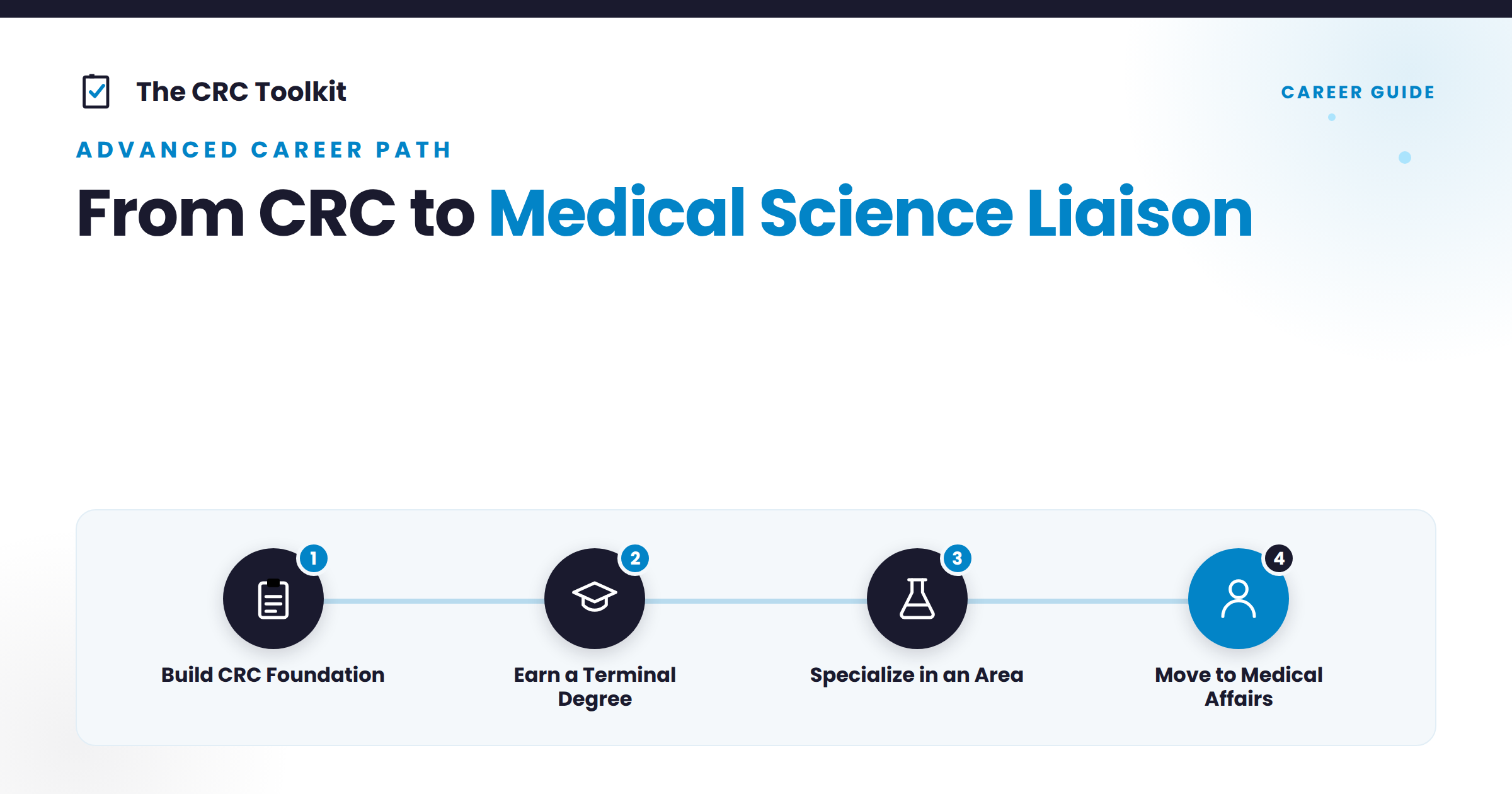
This guide covers the MSL role from the ground up: what MSLs actually do, the FDA regulatory framework that governs their scientific exchange activities, the education and credentials required, salary data from the Bureau of Labor Statistics, and, critically, how the specific competencies built during clinical research coordination work position you for this transition.
What Is a Medical Science Liaison?
A Medical Science Liaison is a field-based scientific expert employed by a pharmaceutical, biotechnology, or medical device company whose primary function is to establish and maintain peer-level scientific relationships with key opinion leaders (KOLs) — leading clinicians, academic researchers, and specialists in a therapeutic area, and to communicate complex clinical and scientific information accurately and compliantly.
MSLs are part of a company's Medical Affairs function, which is distinct from its commercial (sales and marketing) organization. This distinction is not merely organizational: it is regulatory and ethical. The MSL's mandate is scientific exchange, not promotion. They do not take sales quotas, they do not promote products for uses not supported by approved labeling, and they are bound by the same fundamental obligation that governs all medical communication: accuracy, completeness, and balance.
The role emerged from the pharmaceutical industry's recognition that complex scientific data, particularly from clinical trials — requires expert-level communication to be meaningfully understood and appropriately applied by clinicians. A cardiologist reviewing Phase III trial data on a new antiarrhythmic agent has different questions than an oncologist reviewing Phase II immunotherapy data. MSLs are the people trained to have those conversations at a peer level, drawing on their own advanced scientific backgrounds.
The FDA Regulatory Context for MSL Scientific Exchange
The scientific exchange activities that MSLs conduct exist within a specific FDA regulatory framework. Understanding this framework is not optional background knowledge for MSLs: it is the foundation of compliant practice in the role.
The FDA regulates pharmaceutical company communications to healthcare providers under the Federal Food, Drug, and Cosmetic Act. A company's promotional communications about a drug must be truthful, not misleading, and consistent with the drug's FDA-approved labeling. The line between scientific exchange and promotion is a regulatory one that MSLs navigate every day. The FDA's finalized guidance on Communications From Firms to Health Care Providers Regarding Scientific Information on Unapproved Uses addresses the conditions under which companies can communicate scientific information about uses of their products that are not in the approved labeling, and describes the standards that such communications must meet to remain compliant.
A separate and equally important FDA guidance governs a key aspect of the MSL's daily work: responding to unsolicited requests from healthcare providers for information about a product, including information about unapproved uses. The FDA's guidance on Responding to Unsolicited Requests for Off-Label Information describes FDA's policy that when a healthcare provider asks a company — on their own initiative, not in response to a sales call or promotional program — for scientific or medical information about a product, the company may respond with accurate, non-misleading, balanced scientific information. MSLs are typically the people designated to handle these unsolicited requests at a scientific level.
This regulatory architecture explains why the MSL role is structured the way it is. MSLs are not permitted to proactively promote unapproved uses of their products. But they can respond to scientific questions, discuss clinical trial data, support medical education, and gather real-world insights from clinicians — all within a defined framework of scientific and ethical compliance that is ultimately grounded in FDA's regulatory authority over drug communications.
⚠️ The Compliance Line Is Not Subtle
The distinction between scientific exchange and promotion is one of the most important compliance boundaries in Medical Affairs. An MSL who proactively raises unapproved uses of a product without an unsolicited request from the HCP, or who communicates information in a way that could be considered misleading or incomplete, creates regulatory and legal exposure for their employer. CRCs transitioning to MSL roles must internalize this boundary deeply: it is enforced by FDA, monitored by internal compliance teams, and can result in enforcement action, warning letters, or significant financial penalties for companies that cross it.
MSL vs. Sales Representative: The Critical Distinction
The distinction between an MSL and a pharmaceutical sales representative is not merely one of title or seniority. It is a structural and regulatory distinction that shapes every aspect of how the roles operate.
A pharmaceutical sales representative is a commercial employee. Their function is promotion — communicating with healthcare providers to encourage prescribing of the company's products for their approved indications. Their communications are subject to FDA's advertising and labeling regulations, and any claims they make must be consistent with the FDA-approved label. Sales representatives are not permitted to discuss off-label uses of a product.
An MSL is a Medical Affairs employee. Their function is scientific exchange — peer-level communication about clinical data, disease state knowledge, medical education, and research insights. MSLs are not permitted to engage in promotion. They do not carry sales quotas, their performance is not measured by prescribing volume, and they do not report to the commercial organization. This independence from the commercial function is both an ethical requirement and a regulatory expectation: it is what makes the scientific exchange activities MSLs conduct permissible under FDA's framework.
For CRCs considering this transition, the practical implication is that the MSL role is evaluated on scientific credibility, relationship quality, and medical education outcomes, not on sales performance. The competencies that make someone effective as an MSL are scientific communication skills, clinical data literacy, and the ability to establish trust with highly educated, skeptical specialists. These are competencies that CRC work builds directly.
What Medical Science Liaisons Actually Do
The MSL's day-to-day work falls into several distinct functional areas. The balance among them varies by company, therapeutic area, product lifecycle stage, and the specific MSL's territory and KOL relationships.
KOL Engagement and Peer-to-Peer Scientific Exchange
The core of MSL work is one-on-one or small-group scientific discussions with leading physicians and researchers in a therapeutic area. These are not product presentations. They are scientific conversations. An MSL in oncology might discuss the mechanism of action of a novel checkpoint inhibitor with a research-focused oncologist, walk through the clinical trial design and endpoint selection of a Phase III study, or explore the implications of a biomarker finding that emerged in a subgroup analysis. The MSL must be able to engage at the same scientific level as their KOL counterpart, which is why the terminal degree requirement exists.
Responding to Unsolicited Medical Information Requests
When healthcare providers submit unsolicited requests for medical information — about efficacy data, safety profiles, drug interactions, or clinical use in specific patient populations — MSLs are often the people who respond to the more complex scientific questions. This work requires the ability to rapidly retrieve, synthesize, and communicate peer-reviewed clinical data in an accurate, balanced, and non-misleading way, consistent with FDA's guidance on responding to such requests.
Supporting Clinical Trials and Investigator-Initiated Research
MSLs often play a role in identifying clinical investigators and sites for company-sponsored trials, providing scientific support to investigators conducting research on the company's products, and facilitating the flow of real-world clinical insights back to the company's medical and R&D teams. For CRCs, this aspect of the MSL role will feel familiar: it is an outward-facing extension of the trial support function, operating at the research network rather than site level.
Medical Conference Support and Scientific Education
MSLs attend major medical congresses to engage with the scientific community, support medical education activities, and gather insights about evolving treatment landscapes and unmet medical needs. They may present data at advisory board meetings, support continuing medical education programs, or brief internal teams on emerging competitive data or clinical practice trends.
Internal Medical Knowledge Transfer
A substantial part of the MSL role involves translating field insights, what clinicians are observing in real-world practice, what questions they have that current trial data doesn't address, what barriers exist to appropriate use of treatments — back to the company's Medical Affairs, R&D, and commercial teams. This bidirectional flow of scientific information is one of the MSL function's most valuable contributions to a company's medical strategy.
Education and Credentials: What MSL Roles Require
The barrier to entry for MSL roles is high and credential-specific. This is not a role that experience alone can substitute for: it requires an advanced scientific degree that establishes peer-level credibility with the physicians and researchers MSLs are tasked with engaging.
Terminal Degree Requirement
The vast majority of MSL roles require one of three terminal degrees: a Doctor of Philosophy (PhD) in a life science field relevant to the therapeutic area, a Doctor of Pharmacy (PharmD), or a Doctor of Medicine (MD). The Bureau of Labor Statistics Occupational Outlook Handbook for Medical Scientists, the closest BLS occupational category to MSL-type roles, notes that medical scientists typically have a PhD, and sometimes are certified medical doctors as well. The scientific knowledge and analytical training associated with doctoral-level education is what enables the peer-level scientific conversations that define the MSL role.
PharmD holders are well-represented in MSL roles, particularly in therapeutic areas with complex pharmacology or drug interaction considerations. The BLS Occupational Outlook Handbook for Pharmacists notes that pharmaceutical industry pharmacists work in areas such as marketing, sales, or research and development, including designing or conducting clinical trials. PharmD holders who have also worked in clinical research have a particularly strong combination of clinical pharmacology knowledge and trial execution experience.
A small number of MSL roles accept candidates with a Master's degree plus substantial relevant clinical or research experience, but these are exceptions rather than the rule, concentrated in specific therapeutic areas or smaller companies. CRCs without a terminal degree who are interested in the MSL path should plan for the credential investment as a prerequisite to the transition.
Therapeutic Area Expertise
MSLs are hired for deep knowledge in a specific therapeutic area — oncology, immunology, rare disease, cardiovascular, neuroscience, or another specialty. Companies hire MSLs to support specific products or product portfolios, and the scientific credibility they bring must be relevant to the conversations they will have with KOLs in that space. A PhD in molecular biology may be foundational, but MSL candidates in oncology are expected to have deep familiarity with the clinical landscape of the specific tumor types their product addresses, the competing treatment options, and the clinical trial data in that space.
Career Outlook and Salary Context
The BLS does not maintain a specific occupational category for Medical Science Liaisons. MSLs most commonly fall within the BLS's Medical Scientists (SOC 19-1042) category. According to the BLS Occupational Outlook Handbook, the median annual wage for medical scientists was $100,590 in May 2024. Employment of medical scientists is projected to grow 9 percent from 2024 to 2034, much faster than the average for all occupations. About 9,600 openings for medical scientists are projected each year on average over the decade.
MSL-specific compensation typically exceeds the broader medical scientist median due to the industry context and the seniority of the relationships involved. The BLS notes that medical scientists held about 165,300 jobs in 2024, with pharmaceutical and medicine manufacturing among the major employing industries. The broader life, physical, and social science occupations group had a median annual wage of $78,980 in May 2024, with overall employment projected to grow faster than the average across occupations through 2034.
The career trajectory within Medical Affairs is well-defined: entry-level MSL, senior MSL, senior principal MSL, and management tracks that lead to Regional Medical Director, National Medical Director, or therapeutic area medical leadership roles. At each level, the scientific depth and relationship network required increases, as does the compensation. The combination of advanced degree, therapeutic area expertise, and a track record of building KOL relationships is what drives advancement in the MSL career path.
How CRC Experience Positions You for the MSL Transition
The path from CRC to MSL is not obvious on the surface, the roles operate in different parts of the drug development lifecycle, with different employers and different daily activities. But the competency overlap is substantial, and CRC experience is genuinely valued in MSL hiring for reasons that are specific to the work CRCs do.
Clinical Trial Literacy
CRCs develop a deep, practical understanding of how clinical trials are designed, executed, and documented, an understanding that most MSL candidates with purely academic backgrounds lack. An MSL who has worked as a CRC understands what a protocol deviation means for data integrity, why visit window compliance matters for endpoint validity, how source-to-CRF data quality affects the reliability of a trial's findings, and what the experience of being a trial participant or site staff member actually feels like. This ground-level knowledge is genuinely useful in KOL conversations about trial design, site selection, and real-world implementation challenges.
Regulatory Framework Fluency
CRCs work daily within the framework of ICH GCP, FDA regulations, and IRB requirements. MSLs operate within a different but overlapping regulatory framework — the FDA's rules on pharmaceutical communications. CRCs who understand the regulatory architecture of clinical research have a significant head start on understanding the compliance constraints that govern medical affairs activities. The discipline of knowing where the regulatory line is and why it exists, which CRC work instills deeply, is directly transferable to Medical Affairs compliance practice.
Data Communication Skills
CRCs regularly explain complex clinical information to patients during the informed consent process — translating scientific and medical concepts for people who are not scientists. They also communicate protocol requirements, study procedures, and safety information to patients, families, and clinical staff. This is a form of scientific communication training that not every PhD graduate receives. MSLs need to communicate at two very different levels: peer-to-peer with KOLs (at the highest technical level) and in ways that can be understood by different audiences. CRCs have practiced both.
Understanding of Real-World Evidence
CRCs observe, up close, the gap between controlled trial conditions and real-world clinical practice. They see which protocol requirements create burden for participants, which eligibility criteria exclude patients who would otherwise benefit, and what logistical barriers prevent diverse populations from enrolling. These observations — systematically gathered and communicated through the MSL to the company's Medical Affairs team — are exactly the kind of real-world insights that inform post-approval research programs, label expansion studies, and patient support strategies.
Choosing Your Therapeutic Area Strategically
For CRCs planning the MSL transition, therapeutic area choice is the most important strategic decision. MSL roles are highly specialized, and the hiring process evaluates depth of knowledge in a specific area, not breadth across multiple therapeutic areas. The time to develop that depth is before the job application, not after.
CRCs who have worked primarily on oncology trials are well-positioned for oncology MSL roles. The combination of Phase I–III trial experience in oncology, familiarity with the major clinical trial designs (basket trials, umbrella trials, platform trials), and knowledge of the competitive landscape in specific tumor types is exactly the profile oncology medical affairs teams recruit for.
For CRCs whose trial experience spans multiple therapeutic areas, the strategic choice is to identify the area with the strongest combination of personal scientific interest, depth of existing knowledge, and market demand, and invest in building that expertise to the depth required for a credible MSL application. That investment typically means publishing or presenting scientific work, attending disease-specific medical congresses, developing relationships with academic investigators, and demonstrating the depth of knowledge that distinguishes an MSL candidate from a generalist.
What the Transition Actually Takes
The CRC-to-MSL transition is real, but it requires the terminal degree as a foundation. No combination of clinical research experience substitutes for the advanced scientific training that a PhD, PharmD, or MD provides, and companies cannot hire MSLs without that credential because the peer-level credibility it establishes is not replicable.
For CRCs currently working toward advanced degrees, the most valuable preparation is deliberately building the competencies that distinguish MSL candidates: deep therapeutic area knowledge, scientific communication practice, a network within the clinical research community that can support references and introductions, and a track record of engaging with scientific literature at the level of critical appraisal rather than passive consumption. The Clinical Research Careers overview on this site maps the full spectrum of adjacent roles available to clinical research professionals at different career stages and credential levels.
The MSL path is demanding: it requires sustained investment in scientific expertise that goes well beyond what any single job provides. But for CRCs with the right academic foundation, it represents a career that stays close to the science, engages with the best clinical minds in a field, and contributes to how evidence ultimately reaches and benefits patients.
Verified References & Primary Sources
- BLS — Occupational Outlook Handbook: Medical Scientists — Median annual wage of $100,590 (May 2024), 9% projected employment growth 2024–2034, education requirements, and industry employment data. [Verified via BLS.gov]
- BLS — Occupational Outlook Handbook: Pharmacists — PharmD career paths including pharmaceutical industry roles in research and development and clinical trials. [Verified via BLS.gov]
- BLS — Life, Physical, and Social Science Occupations Overview — Median annual wage of $78,980 (May 2024) and projected employment growth data for the broader occupational group. [Verified via BLS.gov]
- FDA — Communications From Firms to Health Care Providers Regarding Scientific Information on Unapproved Uses — Final guidance establishing the conditions under which companies may communicate scientific information about unapproved uses to healthcare providers.
- FDA — Responding to Unsolicited Requests for Off-Label Information — FDA guidance on the policy that allows companies to respond to unsolicited requests from healthcare providers with accurate, non-misleading scientific information.
- FDA — Investigator Responsibilities: Protecting the Rights, Safety, and Welfare of Study Subjects — Relevant to understanding the investigator-level clinical trial knowledge that CRCs bring to MSL roles.
- ICH E6(R3) — Good Clinical Practice Guideline — The international GCP standard governing clinical trial conduct, representing the regulatory framework fluency CRCs develop and bring to Medical Affairs roles.
Primary Sources & References
All factual claims in this article are verified against the following official regulatory and government sources:
- Communications From Firms to Health Care Providers Regarding Scientific Information on Unapproved Uses
- Responding to Unsolicited Requests for Off-Label Information
- Bureau of Labor Statistics Occupational Outlook Handbook for Medical Scientists
- BLS Occupational Outlook Handbook for Pharmacists
- broader life, physical, and social science occupations group
- FDA — Investigator Responsibilities: Protecting the Rights, Safety, and Welfare of Study Subjects
- ICH E6(R3) — Good Clinical Practice Guideline