ICH E6(R3), adopted January 6, 2025, is the most significant revision to the international Good Clinical Practice guideline since the original document was published in 1996. It is not an addendum or a patch; it is a complete structural rewrite that changes how GCP is organized, how its principles are applied, and what it means for sponsors, monitors, and site staff in practical day-to-day work.
If you are a Clinical Research Coordinator, a site manager, or a clinical research professional preparing for the CCRC or CCRP exam, you need to understand E6(R3), not because everything you learned under E6(R2) is wrong, but because the framework your sponsors and monitors are operating under has fundamentally changed. This guide covers every significant change, why it was made, and what it means on the ground at your site.
What ICH E6 Is — and Why It Matters
The International Council for Harmonisation of Technical Requirements for Pharmaceuticals for Human Use (ICH) is an international body that brings together regulatory authorities and pharmaceutical industry representatives from major regions — the United States (FDA), the European Union (EMA), Japan, Canada, Switzerland, and others — to develop harmonized guidelines for drug development and approval. Its GCP guideline, E6, establishes the ethical and scientific quality standard for designing, conducting, recording, and reporting clinical trials involving human participants.
The significance of the E6 guideline cannot be overstated. When FDA accepts clinical trial data as part of a New Drug Application, it expects that the data was generated in compliance with GCP principles consistent with E6. The same applies to the EMA and other ICH member regulatory authorities. This global harmonization means that a clinical trial conducted in the United States under E6-compliant GCP can generate data that is accepted in the EU, Japan, and other regions — an essential feature of modern multinational drug development.
At the site level, E6 governs the expectations your investigators must meet, the documentation your ISF must contain, how informed consent must be obtained and documented, how source data must be managed, and how your delegation log must reflect the qualifications of your staff. Every training program, every SOP, and every monitoring visit checklist your site uses is ultimately derived from E6.
Why a Complete Revision Was Needed
The original E6 was published in 1996, when electronic data capture was nascent, smartphones did not exist, remote monitoring was logistically impractical, and the concept of a decentralized clinical trial was unknown. The 2016 E6(R2) addendum addressed some of these gaps, introducing risk-based monitoring and acknowledging electronic records, but it did so by adding text to an existing structure that was fundamentally designed for a paper-based, on-site clinical trial world.
By the time the ICH E6(R3) Expert Working Group began its work in 2019, clinical research had evolved substantially. Sponsors were running trials that enrolled participants across dozens of countries, collected data from wearable devices, used electronic health records as source documents, obtained informed consent via secure digital platforms, and deployed remote and centralized monitoring strategies that never required a CRA to physically visit a site. The E6(R2) framework was not designed for any of this, and attempting to apply it to these new trial designs created uncertainty, inconsistency, and unnecessary compliance burden.
The E6(R3) revision was designed from the ground up to address this gap. According to the ICH's Step 4 announcement, E6(R3) was developed to provide a framework that is flexible enough to accommodate technological innovation and diverse trial designs while maintaining the core commitments to participant protection and data reliability that define GCP.
Global Implementation Timeline
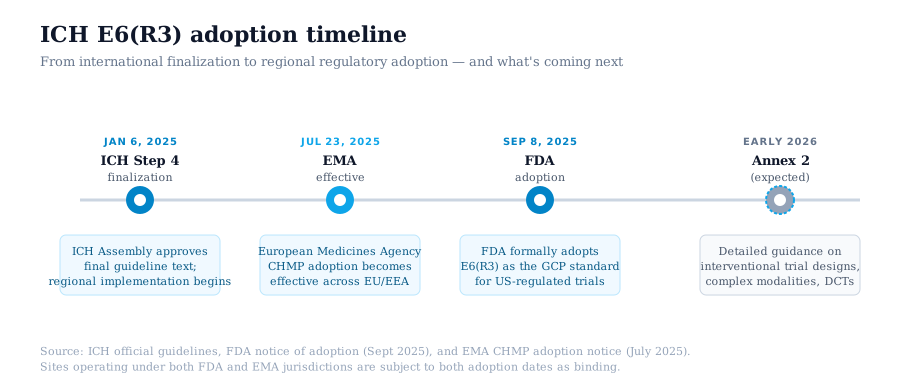
| Date | Event |
|---|---|
| January 6, 2025 | ICH formally adopted E6(R3) Principles and Annex 1 at Step 4 of the ICH process |
| June 11, 2025 | E6(R2) ceased to be in force — transition period ended |
| July 23, 2025 | EMA (European Union) — E6(R3) legally effective for new clinical trials |
| August 15, 2025 | Swissmedic (Switzerland) — E6(R3) implemented |
| September 9, 2025 | FDA (United States) — published E6(R3) as final guidance in the Federal Register |
| 2026 | Check SOCRA and ACRP directly for current exam content outline updates |
| January 12, 2026 | MHRA (United Kingdom) — released UK-specific annotations to E6(R3) |
| 2026 (ongoing) | Annex 2 (decentralized and non-traditional trials), in draft, under public consultation |
⚠️ FDA Status: Guidance, Not Regulation
The FDA's September 9, 2025 publication of E6(R3) as final guidance means E6(R3) represents the FDA's current thinking on GCP for clinical trials, but FDA guidance documents do not by themselves create legally enforceable obligations. The underlying U.S. regulations (21 CFR Parts 50, 56, and 312) remain unchanged. The FDA has not set a formal U.S. compliance deadline. U.S. sites should align with E6(R3) principles now and follow their sponsors' updated SOPs, while monitoring FDA for any regulatory rule changes.
New Document Structure: Principles, Annex 1, and Annex 2
One of the most immediately visible changes is the structure of the document itself. E6(R2) was a single integrated text. E6(R3) is organized into three distinct parts:
Principles — overarching ethical and scientific principles applicable to all clinical trials, regardless of design, therapeutic area, or technology used. The Principles are the philosophical foundation of E6(R3): they establish what GCP is for and why it exists, without prescribing how those goals must be achieved in any specific trial context.
Annex 1 — detailed guidance for traditional interventional trials of investigational medicinal products. This is where the operational content of E6(R2) lives in updated form. Annex 1 covers investigator responsibilities, ISF requirements, monitoring, informed consent, data management, sponsor obligations, and all the specific procedural guidance that site staff apply in day-to-day trial work. For most clinical research coordinators working on pharmaceutical trials, Annex 1 is the part of E6(R3) that is directly relevant to their work.
Annex 2 — guidance for non-traditional trials: decentralized trials, adaptive designs, registry-based studies, trials using real-world data, and studies incorporating digital health technologies. As of April 2026, Annex 2 is still in draft — the FDA published it as a draft guidance document in December 2024. It is under public consultation and is expected to be finalized in 2026.
This modular structure is deliberate. Future Annexes can be developed and added as clinical research continues to evolve, without requiring a full revision of the Principles or Annex 1. This makes E6(R3) a living framework rather than a document that will need to be replaced wholesale in another decade.
Key Changes at a Glance
| Topic | E6(R2) — 2016 | E6(R3) — 2025 |
|---|---|---|
| Document structure | Single integrated document | Principles + Annex 1 (traditional trials) + Annex 2 (non-traditional, in draft) |
| Quality management | Risk-based monitoring introduced, primarily sponsor-focused | Risk-Based Quality Management (RBQM) is the central organizing principle for all parties |
| Quality by Design | Not explicitly required | Quality must be designed into trials prospectively, not inspected in retrospectively |
| Critical to Quality (CtQ) | Concept not formalized | CtQ factors must be identified prospectively during trial planning |
| Proportionality | Some flexibility acknowledged | Explicitly required: oversight, documentation, and monitoring must be proportionate to trial risk |
| Remote monitoring | Addressed but secondary to on-site | Centralized and remote monitoring explicitly recognized as equally valid approaches |
| Data Governance | No dedicated section | New dedicated section covering data lifecycle, electronic systems, EHRs, and source data from any format |
| Source data | Traditional source documents; paper-centric language | Source data can originate in any format — EHRs, wearables, patient-reported outcomes; validation proportionate to risk |
| Informed consent | Consent as a documented event | Consent as an ongoing dialogue; eConsent explicitly addressed and supported |
| Investigator delegation | Delegation documentation well-defined | Clarified: where activities are routine clinical care, formal delegation documentation may not be required |
| Decentralized trials | Not addressed | Addressed in Annex 2 (draft): telemedicine, home IP delivery, remote SDV |
| Technology | Limited guidance on electronic systems | Wearables, eConsent, EHRs, and digital health technologies explicitly addressed |
Risk-Based Quality Management: The Central Principle
The most significant conceptual shift in E6(R3) is the elevation of Risk-Based Quality Management (RBQM) from a monitoring tool to the organizing principle of the entire guideline. Under E6(R2), risk-based monitoring was introduced as a sensible approach to focusing monitoring resources, a practical improvement, but one that operated within a compliance framework that still defaulted to comprehensive, uniform oversight. E6(R3) goes further: it makes risk-based thinking the foundation of how every party, sponsors, monitors, investigators, and CROs, approaches the design, execution, and oversight of a trial.
The RBQM framework in E6(R3) operates through the concept of Critical to Quality (CtQ) factors, those elements of a trial that are essential to participant safety and data reliability. CtQ factors are not determined by a generic checklist; they must be identified prospectively for each trial during the design phase, based on the specific risks that trial presents. A Phase I first-in-human oncology study has different CtQ factors than a Phase IV post-marketing study in a well-characterized patient population. The proportionate oversight principle means that resources, monitoring visits, data review, quality checks, are directed toward what actually matters for that specific trial, not applied uniformly regardless of risk.
For site staff, the practical implication is a shift in how monitoring visits and central monitoring work. Under E6(R3), you are likely to see sponsors using centralized data review to identify risk signals before deciding whether an on-site visit is warranted, and when monitors do visit, they are likely to focus their time on the data elements that have been identified as critical to quality rather than conducting comprehensive line-by-line source data verification across every data point. Remote and centralized monitoring are not exceptions or workarounds under E6(R3). They are explicitly supported approaches that sponsors can deploy proportionately to their risk assessment.
What CtQ Means at the Site Level
When your sponsor's monitoring plan identifies specific data elements for focused review, rather than requesting 100% SDV, that is the RBQM framework operating as designed. For CRCs, this means real-time data quality on the CtQ elements matters more than ever, because those are the elements under active review. A query on a critical endpoint data point carries more regulatory weight than a query on an administrative field. Understanding which elements your sponsor has designated as critical is the new baseline competency for working within an E6(R3)-aligned monitoring framework.
Quality by Design: Building It In Rather Than Inspecting It Out
E6(R3) introduces Quality by Design (QbD) as a formal requirement, the principle that quality must be designed into a trial from the start rather than identified and corrected after problems arise. This reflects a fundamental shift in how the regulatory community thinks about GCP compliance: from a compliance-checklist model ("did we document this?") to a quality culture model ("did we design this process to produce reliable, trustworthy data?").
The QbD principle has implications at every level of clinical research. At the sponsor level, it means that protocol design, data collection systems, and monitoring strategies must be developed with quality considerations integrated from the start. At the site level, it means that site initiation and training processes should be designed to prevent protocol deviations and data errors, not just to respond to them after monitoring visits reveal problems.
For CRCs, QbD thinking is not abstract. It shows up in practical questions: Is our consent process designed so that participants genuinely understand what they are agreeing to, or are we rushing through a form to get a signature? Is our IP accountability system designed to catch discrepancies before they become findings, or are we reconciling logs reactively when the monitor asks for them? Is our delegation log updated proactively when staff change, or is it a document we update when the monitor notices a gap? E6(R3)'s quality culture orientation asks site staff to think about processes, not just documents.
Data Governance: A New Dedicated Section
One of the most structurally significant additions in E6(R3) is a new, dedicated section on Data Governance, a concept that barely existed in E6(R2). This section addresses the full lifecycle of clinical trial data: from capture and storage through correction, finalization, and archival, with explicit attention to the challenges introduced by modern data sources.
E6(R3)'s Data Governance section explicitly addresses the use of electronic health records as source documents, data from wearable devices and digital health technologies, patient-reported outcomes captured through electronic platforms, and data originating from multiple systems across multiple sites. It establishes that source data can originate in any format or system, the validation and verification requirements must be proportionate to the risk that format or system presents to data integrity, not uniformly applied regardless of context.
The section also clarifies requirements for data corrections: any correction to source data must be traceable, must not obscure the original entry, and must include the reason for the change, the same ALCOA+ principles that have governed paper source documentation now explicitly apply to electronic source data. For CRCs managing source data in EHR systems or electronic data capture platforms, this means understanding how your systems log corrections and whether that audit trail is accessible for sponsor review.
Importantly, E6(R3)'s Data Governance section also addresses safeguarding blinding in data governance — ensuring that unblinding of treatment assignments does not occur inappropriately during data collection and management activities, with specific attention to the additional complexity that centralized data systems introduce.
Technology and Digital Health: From Exception to Standard
Where E6(R2) treated electronic and digital approaches as exceptions to paper-based defaults, E6(R3) treats them as standard options within a technology-neutral framework. The guideline uses media-neutral language throughout — source data is "data" regardless of the format or medium in which it is captured. This framing matters because it removes the implicit assumption that the paper paradigm is the baseline against which digital approaches must be justified.
E6(R3) explicitly addresses several technology categories that were either absent or inadequately covered in E6(R2):
- Electronic informed consent (eConsent) — explicitly recognized as a valid approach to obtaining and documenting informed consent, with requirements for ensuring the process remains genuinely participatory and that participants have the opportunity to ask questions and consider their participation
- Digital health technologies (DHTs) — wearable sensors, mobile health applications, and other devices that collect data outside traditional clinical settings are explicitly addressed, with validation requirements proportionate to the risk those devices present to data reliability
- Electronic health records as source — EHRs are explicitly recognized as valid sources of source data, with guidance on how sponsors and investigators should manage access, data extraction, and audit trail requirements
- Computerized systems — requirements for validation, access control, and audit trails for computerized systems used in clinical trials are clarified and modernized
For CRCs who are already working with eConsent platforms, electronic patient-reported outcome tools, or DHT-generated data streams, E6(R3) provides the regulatory basis for those practices that E6(R2) could only partially support. For CRCs at sites that are still primarily paper-based, E6(R3) signals the direction the field is moving and establishes the framework within which DCT elements will continue to be incorporated into traditional trial designs.
Informed Consent: From Event to Ongoing Dialogue
E6(R3) makes a meaningful reframing of informed consent: from a documented event (obtaining consent before study participation begins) to an ongoing dialogue that continues throughout a participant's involvement in a trial. This framing is not new in practice — experienced CRCs have always understood that the consent relationship with participants is continuous, but E6(R3) formalizes it as a regulatory expectation.
The practical implications include explicit recognition that consent must be revisited when new information emerges that might affect a participant's willingness to continue, not just when a formal protocol amendment triggers a re-consent requirement. It also means that how participants are engaged throughout their participation in a study, whether they are kept informed of relevant developments, whether they have ongoing opportunities to ask questions is a GCP consideration, not just a clinical good practice.
On eConsent specifically, E6(R3) supports electronic consent platforms when they ensure participants can take the time they need, ask questions, and have their responses documented, the same substantive requirements that apply to paper consent processes. The medium is not the standard; the quality of the consent process is.
Annex 2 and Decentralized Trials: The Framework in Progress
Annex 2 is E6(R3)'s response to the rapid growth of decentralized and non-traditional clinical trial designs. It addresses the GCP considerations that arise when trials incorporate: telemedicine visits in place of or in addition to traditional site visits; home collection of biological specimens; direct-to-patient delivery of investigational product; remote assessment of study endpoints; and data collected from digital health technologies operating outside traditional clinical settings.
As of April 2026, Annex 2 remains in draft. The FDA published Annex 2 as a draft guidance document in December 2024, opening it for public consultation. It is anticipated to be finalized in 2026, though no specific date has been confirmed. For sites operating decentralized elements now, the applicable guidance remains the FDA's September 2024 final guidance on Conducting Clinical Trials with Decentralized Elements, which remains in force and covers the practical operational questions that Annex 2 will eventually address within the full GCP framework.
What Stayed the Same
Amid all the changes, it is worth being explicit about what E6(R3) did not change, because the core of GCP is unchanged. The fundamental goal of protecting participant rights, safety, and well-being while generating reliable trial data is identical in E6(R3) to E6(R1) and E6(R2). This has always been the purpose of GCP, and no revision changes it.
Investigator responsibilities are fundamentally similar. The investigator remains accountable for the conduct of the investigation at their site, for the qualifications of their delegated staff, for participant protection, and for data integrity. Delegation documentation remains required — though E6(R3) clarifies that where activities are part of routine clinical care, formal delegation may not be needed for those specific activities.
ALCOA+ data principles still apply. Source data must be attributable, legible, contemporaneous, original, accurate, complete, consistent, enduring, and available, the same standards that have governed source documentation under GCP for decades. Informed consent is still required before any study-specific procedures. The Investigator Site File must still contain the essential documents needed to verify trial conduct — now detailed in Appendix C of Annex 1. IRB/IEC oversight of participant protection remains a central GCP requirement.
What This Means for Your ISF
Your ISF requirements are ultimately set by your sponsor's protocol and their ISF template. E6(R3)'s proportionality principle and the clarified essential document requirements in Annex 1, Appendix C may lead sponsors to streamline their ISF templates for lower-risk studies while maintaining rigorous documentation requirements for higher-risk trials. If your sponsor has updated their ISF template since mid-2025, the changes likely reflect E6(R3) alignment.
If your sponsor has not yet updated their ISF template to reflect E6(R3), E6(R2)-era documentation practices remain acceptable under most current sponsor SOPs. Always follow your sponsor's current template and monitor communications from your sponsor about any planned SOP updates. The transition from E6(R2) to E6(R3) is not instantaneous — sponsors, CROs, and sites are implementing changes on different timelines, and following your sponsor's current guidance is always the right approach.
What This Means for Your CCRC or CCRP Exam
Both ACRP and SOCRA publish Exam Content Outlines that describe the knowledge domains covered by their respective certifications. For the most current scope, check the official Detailed Content Outline (DCO) directly from ACRP (CCRC) and SOCRA (CCRP) before building your study plan.
What we can say is that E6(R3) is the current GCP guideline, and working professionals in clinical research should be familiar with it regardless of certification plans. The most effective preparation for any exam covering GCP is to read the source document. The ICH E6(R3) final guideline is freely available at the ICH website. Its modular structure, Principles section followed by Annex 1, makes it more navigable than E6(R2), and reading it directly is more useful than any summary of it.
Verified References & Primary Sources
- ICH E6(R3) — Good Clinical Practice Guideline, Final Version — Adopted January 6, 2025. The primary source for all E6(R3) content, including Principles, Annex 1, and Appendices. Free download from ICH.
- ICH — E6(R3) Guideline Reaches Step 4 of the ICH Process — Official ICH announcement of final adoption, January 2025. Describes the development process and the guideline's purpose.
- FDA — E6(R3) Good Clinical Practice: Final Guidance for Industry — Published September 9, 2025. FDA's formal adoption of E6(R3) as final guidance. Confirms status as guidance (not binding regulation) for U.S. sites.
- FDA — E6(R3) Good Clinical Practice: Annex 2 (Draft) — Published December 2024. Draft guidance covering non-traditional trial designs, DCT elements, and digital health technologies. Under public consultation as of April 2026.
- FDA — Conducting Clinical Trials With Decentralized Elements — Final guidance, September 2024. The operative FDA guidance for DCT operations while Annex 2 remains in draft.
- 21 CFR Part 312 — Investigational New Drug Application — The underlying U.S. regulation governing clinical trial conduct. Unchanged by E6(R3) guidance publication; remains the enforceable legal standard for U.S. trials.
- FDA — E6(R2) Good Clinical Practice: Integrated Addendum — The prior version of GCP guidance, for reference in understanding what changed between R2 and R3.
Primary Sources & References
All factual claims in this article are verified against the following official regulatory and government sources:
- ICH's Step 4 announcement
- September 9, 2025 publication of E6(R3)
- draft guidance document
- September 2024 final guidance on Conducting Clinical Trials with Decentralized Elements
- ICH E6(R3) final guideline
- 21 CFR Part 312 — Investigational New Drug Application
- FDA — E6(R2) Good Clinical Practice: Integrated Addendum