The Importance of the Industry
Clinical research is the engine of modern medicine, responsible for bringing life-saving drugs and devices from the laboratory to the public. As a professional in this field, you are working in one of the most stable and fastest-growing sectors globally. This creates a high demand for skilled talent across all functional areas.
10–15
Years from Discovery to Approval
The lengthy drug development pipeline creates sustained, long-term demand for clinical research professionals at every level, from site coordinator to regulatory specialist.
Typical Educational Path
Most clinical research careers require a bachelor's degree in a life science or health-related field as a baseline. Advanced degrees (MS, MBA, PhD) are common at the CRA, manager, and specialist levels.
Career Landscape at a Glance
Average Salary Comparison (US)
Earning potential varies significantly by role and level of experience, often doubling when transitioning from a site-based role to a sponsor/CRO role.
Core Competency Snapshot
Different roles demand unique skill sets. Here's a look at the key focus areas for three central roles (Scale of 1-10).
In-Depth Career Profiles
Clinical Research Coordinator (CRC)
The Heart of the Clinical Site
How to Get There
- Bachelor's degree in a life science, nursing, or health-related field is the standard entry requirement.
- Research assistant roles, clinical internships, or CTA positions at CROs are the most common entry points without direct CRC experience.
- GCP training (ICH E6(R3)) should be completed before the first role: it signals readiness and is required before performing any study activities.
- The CCRC (ACRP) and CCRP (SOCRA) certifications require 3,000 verified research hours and are the professional credentials that mark mid-career progression.
What Does the Role Actually Involve?
The CRC is the operational engine of the clinical trial site. Day-to-day responsibilities span four areas: participant management (screening, consent, visit coordination, retention), source documentation (contemporaneous visit notes, adverse event records, IP accountability logs), data management (CRF entry, query resolution, EDC system maintenance), and regulatory compliance (ISF maintenance, IRB submissions, monitoring visit preparation). A CRC managing five to ten active protocols simultaneously balances all of these continuously.
The role requires genuine protocol mastery, not just following checklists but understanding why each requirement exists well enough to catch problems before they become deviations. CRCs who develop this depth of regulatory knowledge are typically the ones who advance most quickly.
Clinical Research Associate (CRA)
The Guardian of Data Integrity
How to Get There
- Bachelor's degree in a life science or nursing is required by most sponsors and CROs.
- Two or more years of CRC experience is the standard prerequisite — CRAs need to know what sites are supposed to do because their job is to verify that it's being done correctly.
- CCRA certification (ACRP) or CCRP (SOCRA) is increasingly expected for mid-level CRA positions.
- Under ICH E6(R3)'s risk-based monitoring framework, CRAs increasingly work with centralized monitoring data and may conduct remote visits alongside traditional on-site SDV.
What Does the Role Actually Involve?
CRAs work on behalf of the sponsor — either directly employed by a pharmaceutical company or contracted through a CRO. Their primary function is source data verification: comparing CRF data against site source records to confirm accuracy. Under ICH E6(R3)'s risk-based monitoring approach, SDV is increasingly targeted to Critical to Quality (CtQ) data elements rather than applied uniformly across all data points.
Beyond SDV, CRAs assess site regulatory binders for completeness, review adverse event documentation and reporting timelines, verify IP accountability, and communicate findings to sites through formal monitoring visit letters. The role has significant autonomy and, for field-based positions, substantial travel, but remote monitoring roles have grown considerably since 2020 and represent a meaningful portion of the CRA workforce today.
Clinical Trial Manager (CTM)
The Conductor of the Study
How to Get There
- Extensive experience (5–8+ years) as a CRA or in a related clinical role.
- Advanced degree (Master's, PhD) can be advantageous.
- Project management certification (PMP) is highly valued.
What Does the Role Actually Involve?
The CTM is accountable for the operational execution of an entire study, typically across multiple sites and countries simultaneously. Responsibilities include managing the CRA team's monitoring activities, overseeing site activation timelines, tracking enrollment against projections, managing study budgets and vendor relationships, and serving as the primary operational contact between the sponsor and external parties. CTMs also own the risk management process for their study, identifying and escalating issues that threaten data quality, participant safety, or timeline.
The transition from CRA to CTM is primarily a shift from individual site responsibility to program-level accountability. Strong project management skills, facility with clinical operations metrics, and the ability to manage multiple competing priorities are what differentiate high-performing CTMs.
Biostatistician
The Architect of Data Analysis
How to Get There
- Master's or PhD in biostatistics or statistics is required.
- Proficiency in programming languages like SAS or R.
- Strong analytical and problem-solving skills are paramount.
What Does the Role Actually Involve?
Biostatisticians are involved across the full drug development lifecycle, not just at the analysis stage. In early development, they contribute to study design — determining the primary endpoint, sample size, randomization scheme, and statistical analysis plan (SAP). During the trial, they support interim analyses and data monitoring committee reviews. At study completion, they execute the pre-specified SAP, produce tables, listings, and figures (TLFs) for the clinical study report, and support regulatory submissions.
For FDA submissions, the biostatistician's analysis is subject to independent replication by FDA statisticians — the analytical rigor required is consequently very high. Programming in SAS is standard in the pharmaceutical industry; R is increasingly common in academic and some industry settings. This role typically requires a graduate degree and is one of the highest-compensated in the clinical research field.
Regulatory Affairs Specialist
The Navigator of Global Regulations
How to Get There
- Bachelor's degree in a scientific field.
- Experience in clinical research or a related healthcare industry is helpful.
- Meticulous attention to detail and strong organizational skills are essential for managing submissions.
What Does the Role Actually Involve?
Regulatory Affairs specialists manage the interface between the drug development organization and regulatory authorities including the FDA, EMA, PMDA, and Health Canada. During clinical development, this means maintaining the IND (21 CFR Part 312), preparing and submitting protocol amendments, managing safety reporting obligations, and coordinating with FDA through meetings and correspondence. Post-study, the role expands to NDA or BLA compilation — organizing the complete evidence package from all clinical and nonclinical studies into the structured submission format FDA requires.
The Regulatory Affairs Certification (RAC), offered by the Regulatory Affairs Professionals Society (RAPS), is the field-specific credential. Strong writing skills, attention to detail, and an ability to navigate complex regulatory frameworks across multiple jurisdictions are the core competencies. This role is increasingly important as global clinical programs require simultaneous regulatory strategy across multiple regions.
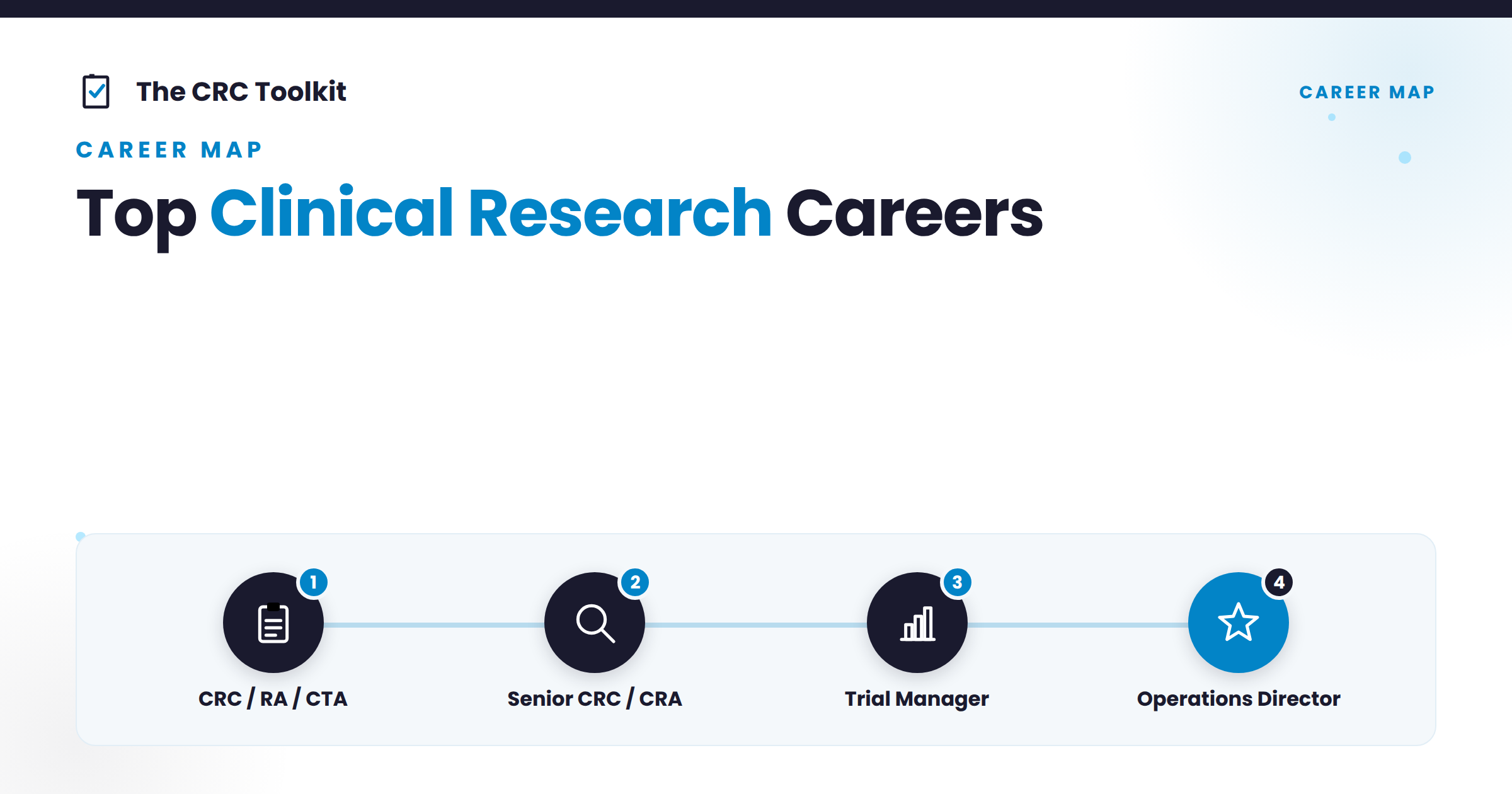
A Common Career Progression Path
Sources
- ACRP — Association of Clinical Research Professionals: Certification requirements and career pathway frameworks. acrpnet.org
- SOCRA — Society of Clinical Research Associates: CCRP certification requirements and role definitions. socra.org
- U.S. Bureau of Labor Statistics — Occupational Outlook Handbook: Medical Scientists, Health Services Managers, and Statisticians occupational data. bls.gov/ooh
- ICH E6(R3) Good Clinical Practice Guideline (January 2025): Risk-based monitoring framework, CRA responsibilities, and CtQ monitoring principles. ich.org
- FDA — E6(R3) Final Guidance (September 2025): FDA adoption of E6(R3) monitoring standards. fda.gov
- 21 CFR Part 312 — Investigational New Drug Application: Regulatory framework governing sponsor, CRA, and investigator responsibilities. ecfr.gov
- RAPS — Regulatory Affairs Professionals Society: RAC certification and regulatory affairs career resources. raps.org